


There’s a (painful) moment every event marketer recognises:
You’ve got a decent-looking website, a solid speaker lineup, and a well-structured agenda; people are flocking in. They’re browsing sessions, clicking on speakers, checking pass prices. And then, they do what you loathe from the bottom of your heart, they leave.
So what do you do? You send another email, run another retargeting ad, add a countdown timer, lower the early bird price, and all that (desperate) jazz.
Here’s the thing: the problem is the gap between interest and decision. Visitors often leave because something in the evaluation process didn’t quite resolve for them. A question went unanswered, a particular session didn’t feel so relevant to them, or the pass options felt confusing. In short, the urgency didn’t feel real yet.
Wait, you’re not the only one going through this rigmarole. Network X, a global telecom and connectivity event with over 5,000 attendees, found this out the hard way. Their site was getting traffic, but something was breaking down between browsing and booking. When they restructured their approach around guided nurture rather than more outreach, the results were: engaged visitors were 48% more likely to reach the registration page, sessions ran 2.4x longer, and return visits from warm audiences grew by 27%.
PS: Keep Network X at the back of your mind; I’ll refer to it again in the next few sections.
TL;DR
- Event registrations often stall between interest and decision, not because people lack intent but because questions during evaluation remain unresolved.
- Visitors typically leave event websites when they feel uncertain about relevance, confused about pass options, overwhelmed by the agenda, or unclear about logistics and value.
- Most event marketing funnels treat every visitor the same, sending identical reminders to people who show very different levels of interest.
- A nurture playbook solves this gap by turning engagement signals such as agenda browsing, pricing page visits, and repeat visits into timely next steps.
- These signals can trigger targeted actions like session recommendations, pass comparison guides, personalised outreach, or logistics guidance.
- Event teams can run this workflow manually using existing tools such as CRM segments, email automation, and website analytics.
Why do event registrations stall even when traffic looks fine?
Event teams tend to read low conversions as lack of intent, as any sane person would. But there’s a difference between someone who isn’t interested and someone who is interested but hasn’t been given a clear enough reason to commit.
The most common blockers look like this:
- Relevance uncertainty: ‘Is this event actually for someone in my role?’
- Agenda overwhelm: Too many sessions, no clear path through them
- Pass confusion: Unclear which tier makes sense for their situation
- Unresolved logistics: Venue, travel, timing questions left hanging
- No urgency: Nothing’s making ‘now’ feel better than ‘later’
- Missing next step: The page ends without telling them what to do
None of these problems is solved by the 99th promotional email that you’ll send out.
Let’s zoom out: Why are most event funnels built backwards?
The standard event marketing funnel works like this: drive traffic to the website, send reminder emails as the deadline approaches, and retarget visitors who didn’t convert. Repeat.
The issue is that they treat everyone the same. Someone who browsed the AI track three times and spent 12 minutes on the pricing page gets the same reminder email as someone who clicked once and never came back. The signal is there, but the response? Nowhere to be found.
Most event platforms generate a wealth of behavioural data, including session views, page revisits, time on site, speaker page interactions, but this data rarely influences what happens next in the marketing sequence. So, interested visitors drift away while the team keeps broadcasting to the whole list.
This is the gap a nurture playbook closes.
What is a nurture playbook?
A nurture playbook is simply a repeatable system for turning engagement signals into timely, relevant actions. It replaces ‘send the same email to everyone’ with ‘respond to what this specific person is showing you.’ In short, a playbook is a set of decisions made in advance about how your team responds to real attendee behaviour.
In practice, that means:
- Identifying which behaviours indicate serious intent (not just casual browsing)
- Deciding what the next best action is for each signal
- Assigning clear ownership: who does what, and when
- Running this consistently, not just in the final week before an event
It doesn’t require a sophisticated AI system to get started. A spreadsheet, a CRM, and some thoughtfully designed email sequences can get you most of the way there. The playbook is a process first. The technology supports it, but doesn’t define it.
Where does the attendee journey break?
Event journeys tend to have four phases: awareness, exploration, evaluation, and registration. Most event marketing activity clusters around the first. The website, email list, and social content are all designed to generate awareness and initial interest.
But the largest drop-off happens in the evaluation phase. This is where attendees are asking deeper questions: Is this relevant to me? Which sessions should I prioritise? Is the cost worth it, given what I’ll get out of it? Do I know enough to feel confident committing?
Without structured guidance at this stage, visitors stay in exploration mode indefinitely. They tell themselves they’ll come back and register when they have a minute, and that’s a lie.
Going back to Network X, they identified this exact problem. Their agenda was extensive and genuinely valuable, but difficult to navigate without help. Attendees struggled to identify the sessions most relevant to their roles, leaving before the value landed. When they introduced guided discovery through an AI concierge, average session time increased by 2.4x. People who understood what was in it for them stayed far longer and converted at a significantly higher rate.
Identifying signals that matter
Not every click is a signal worth acting on. What you’re looking for are behaviours that indicate someone is in evaluation mode: they’ve moved past casual curiosity and are now actively working out whether to commit.
High-value signals tend to fall into a few categories:
- Agenda engagement: returning to the agenda page multiple times, or browsing sessions within the same topic cluster, this suggests someone building their own view of the event’s relevance to them
- Role-based exploration: spending time on speakers or sessions in a specific domain, which tells you what kind of attendee they are and what they care about
- Conversion signals: visiting the pricing page, comparing pass tiers, returning to the registration page without completing, these are people who are almost there
- Logistics signals: searching for venue information, transport details, or accommodation, this often means intent to attend is real but something practical needs resolving
The idea is to watch for moments that signal someone is ready to be helped toward a decision.
Mapping signals to the next best action
Once you know what to look for, the playbook logic is relatively simple: every meaningful signal should trigger a defined next step.
The table below shows how this works in practice.
| Signal | Action | Owner | Timing |
| Agenda browsing (multiple sessions) | Targeted session recommendations | Marketing | Within 24 hours |
| Speaker page exploration | Related session highlight email | Marketing | Same day |
| Pricing page revisit | Pass comparison guide | Marketing | Within 12 hours |
| VIP session browsing | Personalised outreach call | Sales | Within 48 hours |
| Logistics/venue queries | Venue and travel guidance | Support | Instant |
The value of mapping this out in advance is that it removes the need for individual judgment calls in the moment. Your team knows exactly what to do when a particular behaviour shows up. And if you’re using any kind of marketing automation, you can start triggering these actions without manual intervention.
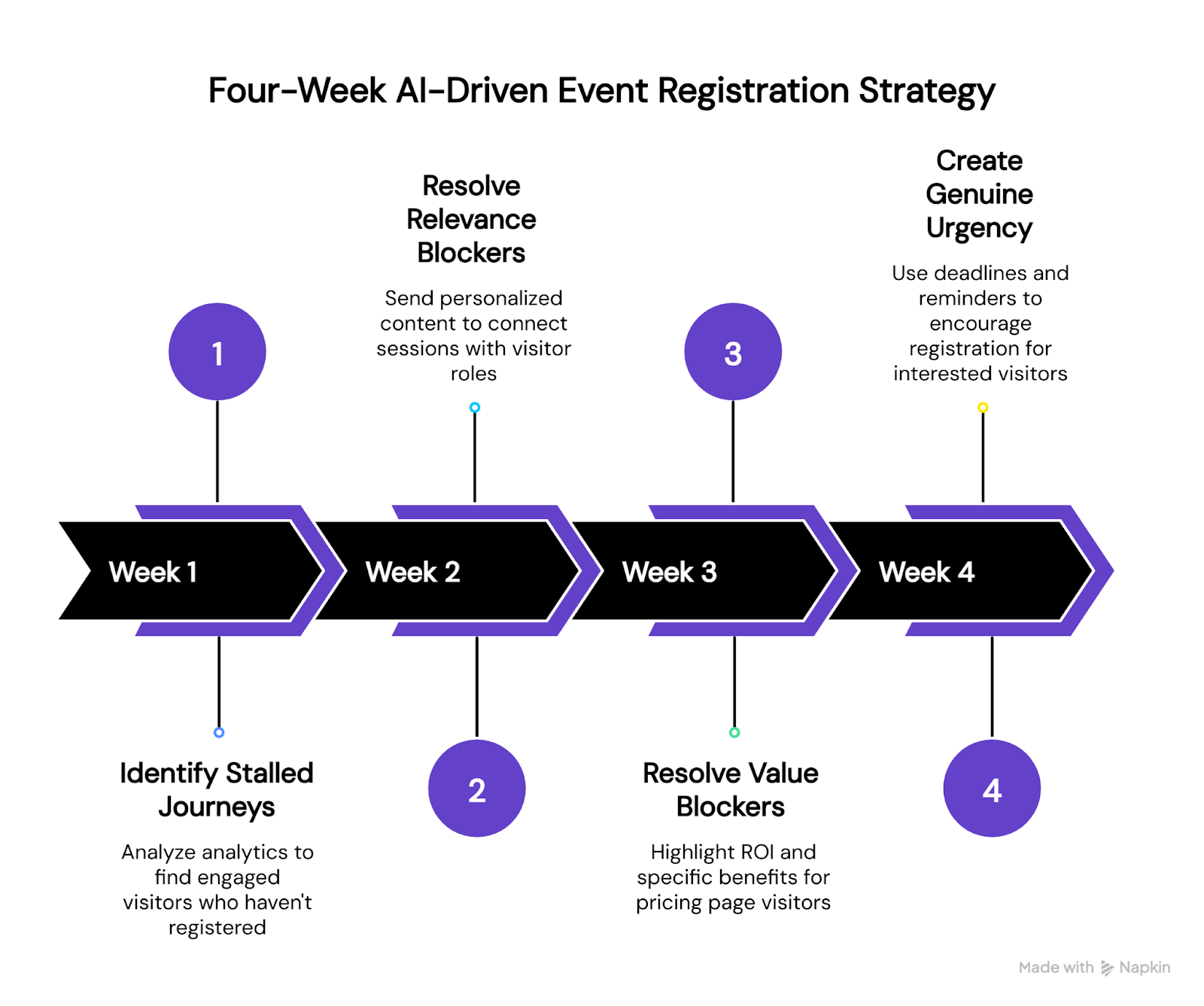
Running a four-week registration conversion sprint
Most registrations happen in the final weeks before an event. That window is your conversion sprint. Instead of using it to send more generic reminders, use it to systematically resolve the blockers that are keeping warm audiences from committing.
Here’s a simple structure:
Week 1: Find the stalled journeys
Pull your analytics and identify visitors who’ve engaged meaningfully but haven’t registered. These are your priority audience. Understand which pages they’ve visited and how many times.
Week 2: Resolve relevance blockers
For visitors who’ve been browsing broadly without going deep, the likely issue is relevance. Send content that connects specific sessions to specific roles or challenges. Help them see themselves in the event.
Week 3: Resolve value blockers
For visitors who’ve been on the pricing page, the question is ROI. What will they get out of attending? Make the value concrete — specific sessions, networking opportunities, practical outcomes.
Week 4: Create genuine urgency
This is where deadlines, limited availability, and personalised reminders earn their place. But urgency only works when the underlying interest is already resolved. If someone is still unsure whether the event is relevant to them, a countdown timer won’t change that.
You don’t need new tech to get started
One of the reasons event teams don’t build nurture systems is the assumption that it requires a sophisticated tech stack, it doesn’t. At least not to get started.
With a CRM, a basic email automation tool, and your existing website analytics, you can run a functional nurture playbook.
The process looks something like this:
- Export your engaged visitor segments from your analytics platform
- Categorise them by the signals they’ve shown, what pages they visited, how often, and in what sequence
- Map each segment to a specific next action from your playbook
- Run targeted campaigns to each segment and track how conversion rates shift
- Iterate based on what’s working
Once you’ve built the process manually, you’ll understand it well enough to know exactly where technology would actually help, rather than buying a platform and hoping it delivers results on its own.
What changes when this becomes a system?
Running a nurture playbook once can make it feel useful. But running it consistently, as a defined system with clear ownership, is transformational.
Here’s what actually happens:
- Consistency: every warm visitor gets a response, not just the ones your team happened to notice
- Personalisation at scale: different visitors receive different guidance based on what they’ve actually shown interest in
- Clear accountability: marketing knows what they own, sales knows what they own, support knows what they own
- Measurability: you can see which signals are most predictive of registration and optimise toward them
The Nurture and Conversion Playbook that Bridged uses with clients is built on this logic: engagement is treated as intentional and structured rather than broad and promotional. The manual steps described above are a great way to get started, but they quickly become difficult to sustain across an entire event portfolio. Our playbook makes the same workflow scalable by connecting the data sources teams already use and turning those signals into consistent responses without adding unnecessary tech debt.
What does success look like?
When a nurture system starts working, the signs aren’t always dramatic at first. But they’re clear if you know what to look for.
You’ll see fewer visitors stuck in the evaluation phase for weeks. You’ll see faster time-to-registration among engaged audiences. You’ll see higher return visit rates from warm prospects. You’ll see clearer attribution between specific engagement behaviours and conversion outcomes.
For Network X, the proof showed up in the data:
2.4× longer average session time among users who engaged with guided discovery
27% higher return rate among engaged visitors; building a warmer, more qualified remarketing pool
48% more likely to reach the registration page compared to unguided visitors
Note: None of those results were due to increased ad spend, they came from making the evaluation journey easier to navigate.
Read the full Network X case study here.
Here’s how you can get started
If you’re not sure where to begin, start small and make it concrete.
Identify three signals that indicate serious attendee intent on your event website
- Write down the single best next action for each signal
- Assign a name to each action: who owns it, and within what timeframe
- Run those three responses for four weeks leading up to your next registration deadline
- Measure whether conversion rates among engaged visitors shift
If you are looking for a way to scale this approach across your event portfolio without adding operational complexity, Bridged’s Nurture and Conversion Playbook can help. It connects the engagement signals already sitting across your website, CRM, and marketing systems, and turns them into structured nurture workflows that guide attendees toward registration.
Book a call with our team to see how the playbook could work for your events.
FAQs
Q1. Why do event registrations drop even when website traffic is high?
Traffic only shows that people are curious about the event. Registration requires a decision, and that decision usually depends on whether visitors can quickly understand the event’s relevance, value, and logistics. If those questions remain unresolved during evaluation, many visitors leave without registering.
Q2. What is a Nurture and Conversion playbook for event marketing?
A nurture and conversion playbook is a repeatable workflow that turns visitor behaviour into the next best action. Instead of sending the same email to everyone, the marketing team responds to engagement signals such as session browsing, speaker exploration, or ticket comparisons with relevant guidance that helps attendees move closer to registration.
Q3. What signals indicate serious attendee intent?
High-intent signals usually appear when visitors enter the evaluation phase. These signals often include:
- Returning to the agenda page multiple times
- Browsing sessions within the same topic cluster
- Reading several speaker bios
- Comparing ticket tiers
- Revisiting the registration page
- Searching for venue or travel information
These behaviours suggest the visitor is actively deciding whether to attend.
Q4. Do event teams need advanced technology to run a nurture system?
No. Many teams assume nurture systems require sophisticated technology, but the early version of a playbook can run with tools they already use. Website analytics, CRM segmentation, and email automation are often enough to begin responding to visitor signals and testing targeted follow-ups.
Q5. What does a four-week registration conversion sprint involve?
A conversion sprint focuses on resolving the main barriers preventing warm audiences from committing.
- Week 1: identify engaged visitors who have not registered
- Week 2: address relevance by connecting sessions to attendee roles
- Week 3: address value by highlighting outcomes and networking benefits
- Week 4: introduce urgency with deadlines and personalised reminders
This structure helps remove decision blockers rather than repeating generic promotion.
Q6. How do nurture systems improve event registration performance?
When nurture systems run consistently, several changes become visible:
- Visitors spend longer exploring event content
- Return visits from warm audiences increase
- The time between the first visit and registration becomes shorter
- Marketing teams gain visibility into which signals predict conversions
Over time, registrations grow because attendees receive the guidance needed to make confident decisions.