


I remember walking into a large conference a few months ago, coffee in hand, slightly rushed, scanning through an agenda that looked great on paper. Multiple tracks, big-name speakers, plenty to choose from.
But fifteen minutes in, I was doing what most attendees end up doing. Scrolling, opening tabs, closing them, trying to figure out what was actually worth my time.
At some point, it hit me. There were too many options, and none of them were helping me decide.
And that’s when it clicked.
Everyone in that room was probably having their own version of this. A founder, a marketer, a buyer, all navigating the same agenda and the same content, even though what they needed was completely different.
That’s usually where engagement starts to dip, not because the event lacks value, but because it doesn’t feel relevant to the person experiencing it.
That is exactly where hyper-personalisation for events becomes valuable.
What hyper-personalisation for events actually means
Before getting into how to do this, it helps to reset what we mean by personalisation.
This is not about tracking people aggressively or building complex one-to-one journeys that are impossible to manage.
It is also not about adding more recommendations or creating “smart” matchmaking features that sound good in demos but rarely get used meaningfully.
A more useful definition is this:
Hyper-personalisation for events is the ability to adapt the event experience in real time based on what an attendee is actually interested in and how that interest changes as they explore.
When this works well, it feels almost invisible.
Attendees find what they need faster, they spend more time in sessions that actually matter to them, and they have better conversations. The event feels intentional rather than overwhelming.
Why most event experiences still feel generic
Most teams don’t think they have a personalisation problem because they have tracks, they segment audiences, and they send targeted emails. On the surface, it feels like the basics are covered.
The issue shows up later, once the event actually begins.
Everyone still ends up navigating long agendas, discovery takes heavy effort, sponsor interactions depend on chance, and the responsibility of figuring out ‘what matters to me’ sits entirely with the attendee.
If you step back, the reason is quite simple:
The experience is static (but the attendees are very dynamic).
But why does this happen? It’s because the agenda is built once, tracks are defined once, and the structure is locked in early. After that, every attendee enters the same system, regardless of what they actually care about.
This might work when the event is small and the audience is relatively similar. But as things scale, it starts to break. You see strong attendance, but engagement begins to flatten.
Now, most events try to fix this with segmentation.
You group attendees by role or industry, highlight recommended sessions, create curated tracks, and all of that helps at the surface level.
But once attendees enter the experience, everything becomes self-serve again. They scroll, search, and try to piece together their own journey.
And this is where the real gap shows up A LOT because intent doesn’t stay fixed.
Someone might arrive wanting to explore trends, shift into vendor evaluation after a session, and then prioritise networking after a conversation. The journey keeps changing, but the experience doesn’t adapt to it, unfortunately.
So even though intent exists throughout the event, it’s not being moulded as per intent, and that’s where most of the value gets lost.
What changes when you personalise the event experience properly
If there’s one thing this shift isn’t about, it’s adding more features. It is about changing how the experience responds to behaviour.
Instead of one fixed journey, you start designing for movement.
As attendees explore sessions, search topics, or engage with content, those signals begin to influence what they see next. The agenda they experience starts to look slightly different. The content they discover becomes more relevant. The suggestions they receive feel timely.
You’re guiding them towards what matters right now. That’s the core idea behind a hyper-personalised experience, and it is exactly what the playbook approach is designed to enable.
A practical way to implement this (without overcomplicating it)
You don’t need a complex system to get started. In fact, most teams overthink this and try to personalise everything at once.
I’ve found it works much better when you keep it simple and build from there.
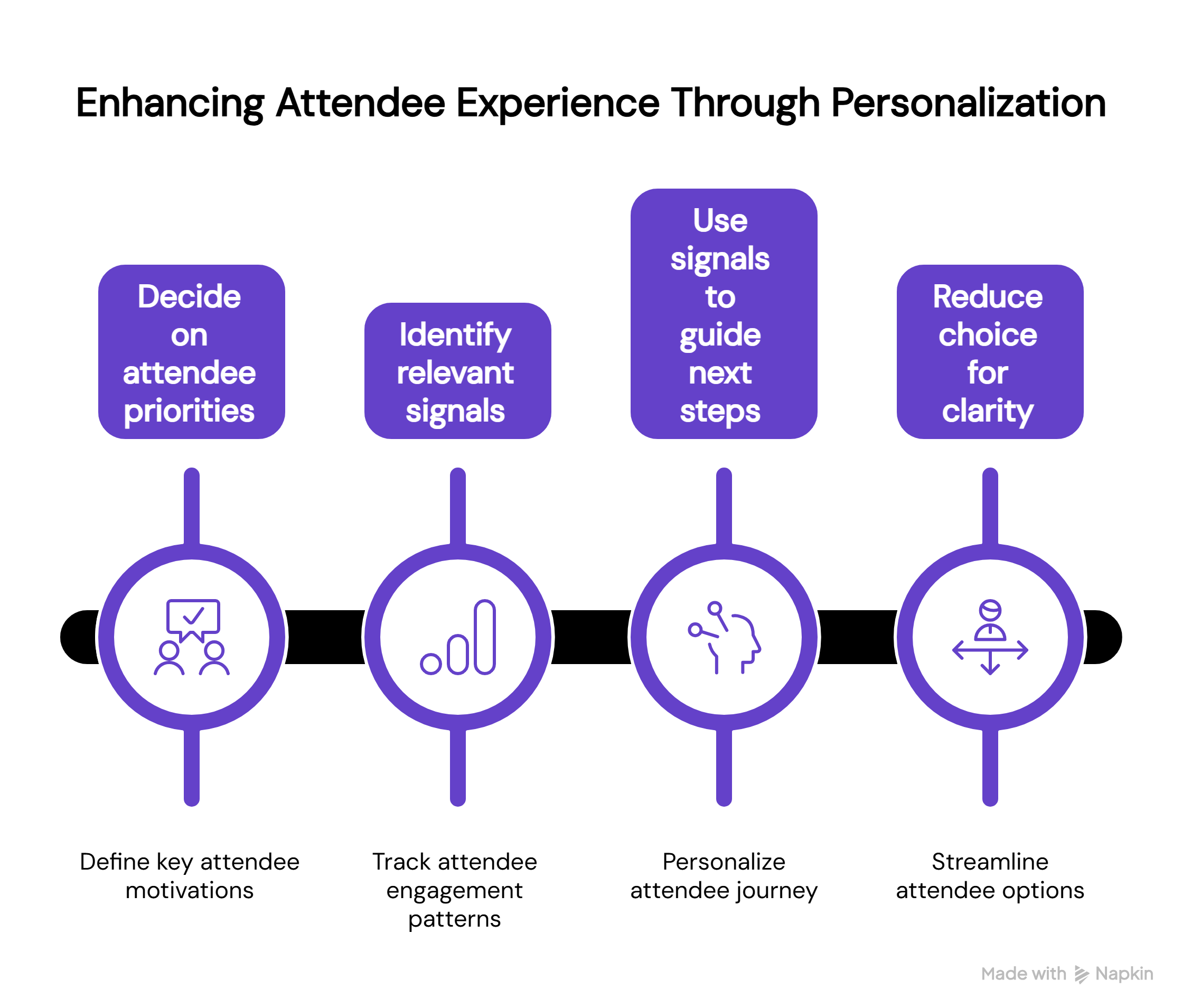
1. Decide on the few attendee priorities you want to support
Start by defining what people are actually coming for.
In most events, this usually falls into a few buckets. Some attendees want to learn. Some are evaluating vendors. Some are there to network. Others are exploring the market.
You don’t need ten segments. You need clarity on a few meaningful ones.
Once you have that, everything else becomes easier to structure.
2. Identify the signals that actually matter
Not all engagement is useful, but to put it broadly, the signals that really matter indicate intent.
What sessions are people viewing or saving? What topics are they searching for? What questions are they asking? Which sponsors or content pieces are they spending time on?
These are not just interactions. They are clues.
This approach focuses heavily on identifying these behaviour patterns because they are what allow the experience to adapt meaningfully.
3. Use those signals to guide what comes next
Instead of expecting attendees to figure things out on their own, you start guiding them based on what they have already shown interest in.
If someone is exploring a specific topic, you can surface relevant sessions. If they are engaging with certain sponsors, you can introduce related ones. If they ask a question, you can help them move forward with a clear next step.
What I like about this approach is that it does not feel forced.
The experience becomes responsive rather than promotional.
4. Reduce choice instead of increasing it
When they think about personalisation, they try to add more recommendations, more options, more pathways. But what actually improves the experience is reducing noise.
A good experience makes it easier to decide, not harder.
When attendees see fewer, more relevant options, they move faster. They engage more deeply. They feel like the event understands what they need. And that’s where perceived value starts to increase.
How does this play out across the event lifecycle?
Once you start thinking this way, you realise it is not limited to a single moment in the event.
It shows up everywhere.
During agenda planning, you guide attendees towards sessions that match their priorities. During content discovery, you help them evaluate relevance. During the event itself, you surface sessions and sponsors in real time based on behaviour.
Even after the event, you can continue that journey by aligning follow-ups with what they actually engaged with, rather than sending generic recaps. The experience becomes continuous.
What does proof look like?
One of the most useful ways to evaluate whether this is working is to look at alignment.
- Are people attending sessions that match what they explored earlier?
- Are they engaging more with content that reflects their interests?
- Are sponsor interactions becoming more relevant?
This alignment between intent and behaviour is one of the clearest indicators of a well-designed experience.
You’ll also see it in smaller signals such as:
- Attendees spend more time in the right sessions
- Conversations become more meaningful
- High-value attendees report a better experience. Sponsors notice an improvement in interaction quality.
None of this comes from adding more; it comes from guiding better.
This is not just a better experience in theory. It can materially improve how people move through the funnel.
For example, at Network X, Bridged helped visitors discover relevant sessions, speakers, and event information more intuitively, while also guiding them towards the right pass and registration pages.
The result was 2.4x longer sessions, a 27% higher return rate, and visitors being 48% more likely to reach the registration page. That is what happens when discovery becomes more relevant and the next step becomes clearer.
Start simple, then make it repeatable
If you’re trying to implement this, the most important thing is not to over-engineer it at the start.
You can do a surprising amount with simple segmentation, a few behavioural signals, and clear rules for what to surface next. For many teams, that is the right place to begin.
The challenge starts when you want to scale this.
It is no longer just about improving one attendee journey. It becomes about making personalisation consistent across larger events, multiple editions, and different audience types, without adding more manual work for your team.
That is where a more structured approach becomes useful.
Bridged’s Hyper-Personalisation Playbook is designed to help teams do exactly this. It focuses on identifying meaningful interest and behaviour patterns, dynamically adapting agendas and content discovery, and surfacing relevant sessions, sponsors, and guidance as attendee intent evolves.
The goal is not to make the experience more complex.
It is to make it more relevant, in a way that can be repeated across your entire event portfolio.
If you’re starting to think about how to take personalisation beyond a one-off improvement and make it work consistently across events, it’s worth exploring what that could look like in practice.
In a nutshell…
If there is one thing I would take away from all of this, it’s this:
Personalisation is not about making events more complex.
It is about making them feel more relevant.
And most of the time, that comes down to helping people get to what matters, a little faster, and with a little more clarity than they would on their own.