



I have yet to meet an awards producer who says, “We have too much spare time during awards season.”
Awards programmes are intense… think of a spin session in a sauna. They are also cyclical (that’s why I said “spin”… get it?) and high-stakes for entrants, sponsors, judges, and internal teams.
And every season, the same friction appears.
Before the deadline, the ops inbox fills with repeat questions. During judging, submissions vary wildly in quality. Sponsors want clear proof of value and ROI. And after the ceremony, reporting often feels rushed and incomplete. Then planning for the next cycle begins, often without structured insight from the last one.
Awards programmes often get stuck in the manual gap, the gap between visible intent and structured action.
AI can close that gap by reducing operational friction, improving entry quality, making sponsor value measurable, and turning seasonal activity into repeatable insight. Humans are obviously very much part of the process… holding clear judgment and editorial control.
TL;DR
- AI improves awards programmes by reducing operational friction and structuring intent signals into measurable outcomes.
- Entry completion increases when repetitive questions are answered instantly and drop-offs are detected in real time.
- Sponsor value becomes easier to defend when high-intent interactions are clearly captured and attributed.
- Performance intelligence turns each awards season into a learning system rather than a reset cycle.
- AI supports speed, consistency, and insight while keeping judgment and editorial decisions fully human-led.
- Awards programmes that structure intent before, during, and after the season convert better, renew stronger, and improve year over year.
But how does the whole AI part work across the full awards lifecycle? Let’s find out.
What’s the problem with award programmes today?
Let me start with the honest debrief, awards teams experience the same old but heavily nerve-blocking pressure points every season:
- Repetitive entrant questions about eligibility, categories, and pricing
- Category confusion leading to poor-fit submissions
- Entry drop-offs midway through the form
- Judging bottlenecks caused by inconsistent submissions
- Sponsors asking what they really got
- Post-season reporting chaos
These problems are mostly… structural:
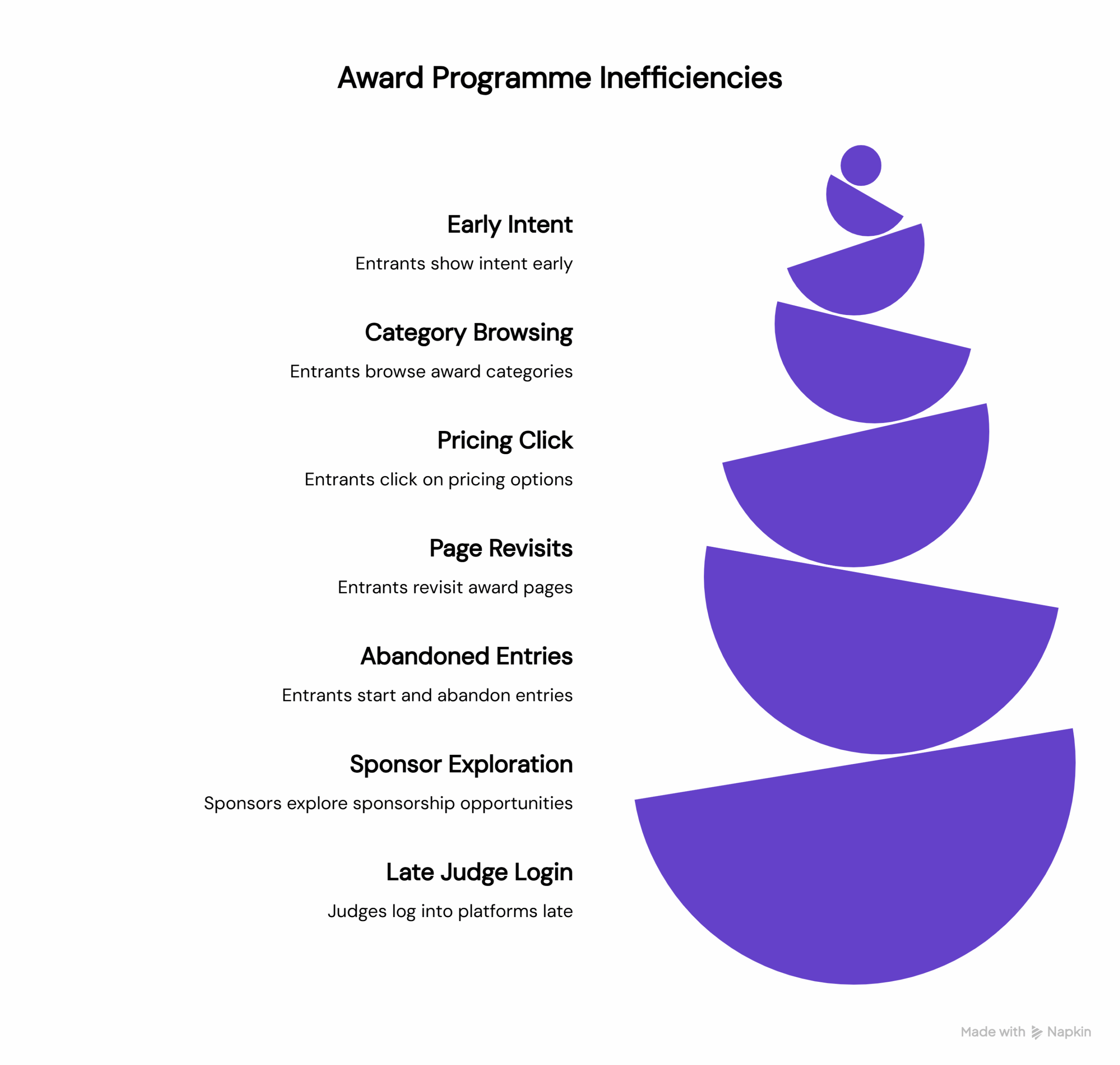
1. Entrants show intent early
2. They browse categories
3. They click pricing
4. They revisit pages
5. They start entries and abandon them
6. Sponsors explore opportunities
7. Judges log into platforms late
All of this data exists, but it’s not consistently activated. If you’re thinking, “What does that even mean?”… good question.
It means that most awards programmes operate reactively; they wait for these things:
An entrant emails a question; someone replies manually, and then another entrant asks the same question two days later, and that someone pulls their hair out. Now, moving on, marketing sends reminder emails before deadlines, teams chase sponsor renewals using broad engagement summaries, and ops teams scramble during peak weeks.
After the ceremony, someone exports spreadsheets and tries to build a narrative from fragmented data.
Every season becomes a sprint, leaving everyone gasping for breath.
What does the future look like, with AI in it?
An AI-native awards programme runs differently.
- Intent signals are captured and acted on as they appear.
- Repetitive questions are answered instantly using approved guidance.
- Entrants are guided toward better categories.
- Sponsor interactions are tagged in real time.
- Seasonal data becomes a learning system.
All this, but editorial and judging decisions remain human, while execution becomes structured. Let’s see what it looks like.
Four AI-native playbooks that awards teams actually recognise
Note: These playbooks are built around the moments that award-winning teams live through every season.
1. Entry support and completion
Two weeks before the deadline, your inbox explodes, and then come the questions from entrants:
- Which category fits my submission?
- Am I eligible?
- What does a strong entry look like?
- Can I edit after starting?
You respond, then you respond again… and again, until you eventually quit your job.
The issue is confusion and delay. When support slows down and guidance varies, submission quality drops, and entrants stop in their tracks, and then obviously, judges spend time interpreting unclear entries.
Most teams rely on:
- Static FAQs
- Manual inbox replies
- Generic reminder emails
- Late-stage panic nudges
So, what exactly changes when support becomes structured?
A chat interface trained on your awards guidelines and submission criteria can:
- Answer category and eligibility questions instantly across web, email, or WhatsApp
- Detect when someone starts an entry but stalls and prompt them toward completion
- Provide consistent, approved guidance aligned to judging standards
- Reduce repetitive queries during peak weeks without increasing headcount
The goal is that entrants get clear answers immediately. Judges receive stronger submissions. Your ops team is no longer overwhelmed by the same questions repeated over and over.
The impact is practical:
- Higher completion rates
- Stronger entry quality
- Less operational strain
- Cleaner judging workflows
One producer described it as ‘finally having support that does not depend on who is on shift.’
2. Sponsor value and insight
After the ceremony, sponsors ask a simple question… ‘what did we actually get?’
Most awards teams share slides covering impressions, logo exposure, or engagement totals. The data looks busy and nice on paper, but it doesn’t make its way to decision-making.
High-intent moments already exist:
- Category exploration spikes
- Nominee engagement surges
- Voting activity increases
- Specific themes trend
But these signals often stay put in dashboards rather than feed sponsor products.
Now, when sponsor intent is structured in real-time:
- Category exploration can trigger sponsor-aligned placements
- Nominee activity can route audiences to defined sponsor touchpoints
- Voting behaviour can activate sponsor-owned experiences
- Every interaction can be tagged to a specific sponsor product
Reporting becomes clearer and easier to defend these things:
- Who engaged
- What they did
- How those actions progressed
Sponsors can then describe ownership and progression rather than exposure. That distinction matters internally when budgets are reviewed.
3. Performance intelligence
Once awards season ends, planning for the next cycle begins almost immediately.
Common questions surface:
- Which categories grew?
- Where did drop-offs occur?
- Which entrant segments converted best?
- Which sponsor products renewed fastest?
Most teams answer by exporting spreadsheets and reconstructing the story manually.
The real issue is fragmentation. Data lives across entry systems, marketing tools, support channels, and commercial reports. Insights are assembled, not generated.
When performance intelligence is structured:
- Entries, engagement, sponsor outcomes, and revenue sit in one view
- Drop-off patterns become visible
- High-performing categories are benchmarked year-on-year
- Sponsor renewal patterns are measurable
Awards programmes begin to improve deliberately rather than repeating patterns by memory.
The shift is subtle but powerful. You stop reacting to what happened. You start adjusting based on evidence.
4. Revenue acceleration
Many awards programmes experience stable but flat growth.
Entry spikes cluster around deadlines. Sponsor packages feel predictable. Upsell happens manually, if at all.
Yet intent signals are visible every day:
- Repeated pricing page visits
- Premium category exploration
- Partial entries without upgrade
- Past entrants revisiting
These are commercial indicators, and with structured activation and personalisation, they can:
- High-fit past entrants are identified early
- Behaviour-based nudges trigger automatically
- Pricing clicks route toward relevant upgrades
- Category suggestions adapt to browsing behaviour
Instead of pushing reminders broadly, you respond to visible intent.
Revenue growth becomes less dependent on urgency spikes and more tied to behaviour patterns.
The increase does not come from working harder. It comes from acting at the right moment.
What ties these playbooks together
Across all four areas, the pattern is consistent:
Awards teams already generate the signals. Entry behaviour, category exploration, sponsor engagement, voting spikes, pricing clicks. The challenge is not data scarcity. It is fragmentation.
Most programmes do not have a single operational layer that unifies those signals and acts on them consistently.
When those signals are brought into one central command layer, they stop sitting in separate dashboards and start triggering structured workflows. Entry behaviour can activate completion nudges. Category exploration can inform sponsor routing. Sponsor engagement can feed renewal reporting. Performance data can shape next season’s design.
AI in awards does not replace editorial judgement. It reduces repetition, captures intent, and structures action across the entire lifecycle.
The result is:
- Cleaner entries
- Stronger sponsor value
- Smarter planning
- More stable revenue
And most importantly, each season compounds instead of resetting. What you learn before deadlines informs judging. What you learn during judging informs sponsor reporting. What you learn after the ceremony shapes next year’s growth strategy.
That is the difference between running an awards season and building an awards system.
Before, during and after awards season
Let’s zoom out.
-
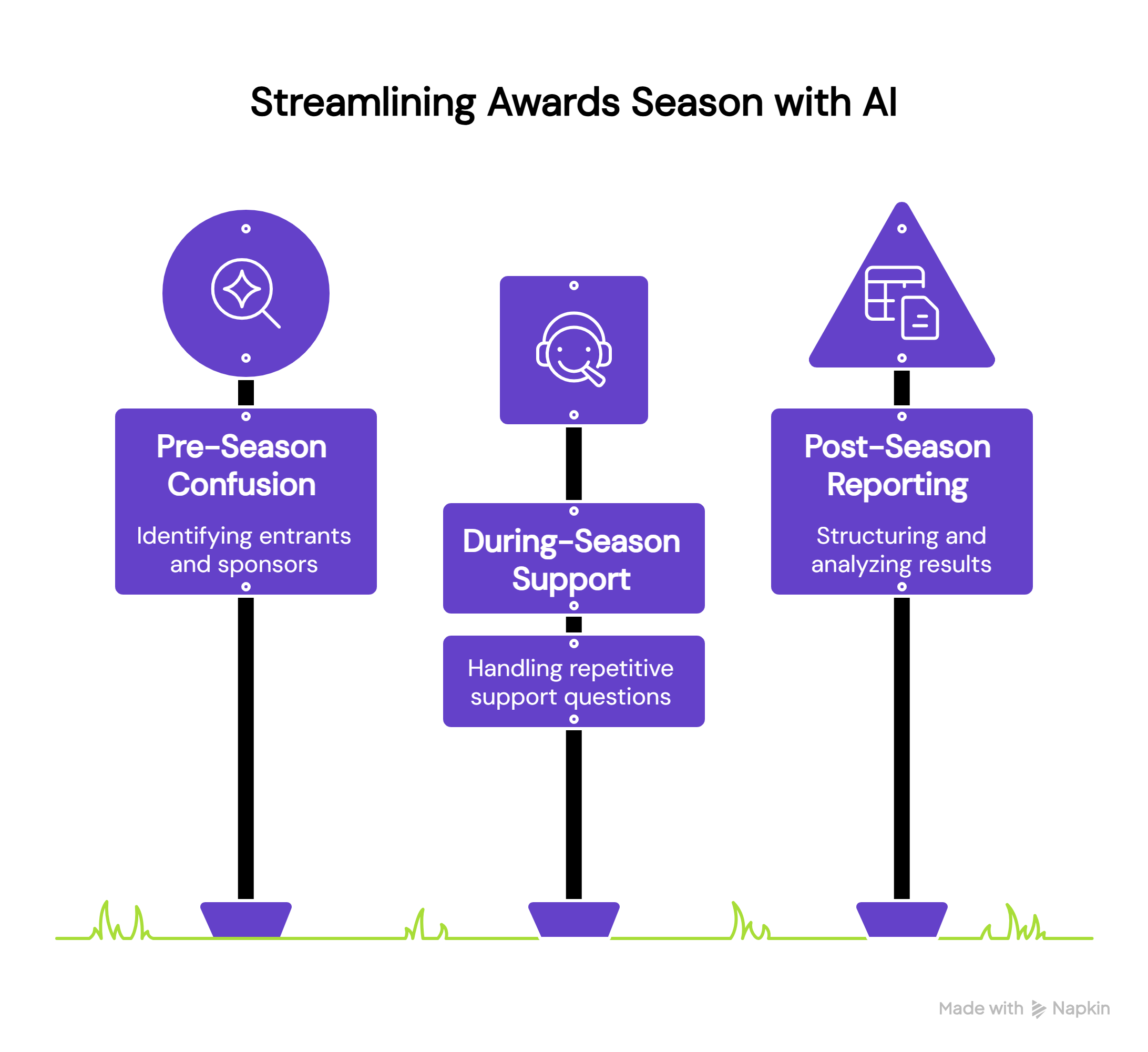
Before season
AI helps identify high-fit entrants and sponsors, guiding them into the right categories and reducing confusion before deadlines start creating panic.
-
During season
Repetitive support questions are deflected, entry quality improves, sponsor interactions are tagged, and judges experience cleaner workflows… everyone’s getting good sleep.
-
After season
Reporting feels (and becomes) structured, sponsor renewals are supported by clearer proof, category performance is benchmarked, and planning for the next season becomes data-informed.
The programme compounds instead of resetting.
Human-led AI adoption
This section’s important because it tells you exactly what AI will not do.
- AI does not decide winners
- AI does not override judges
- AI does not edit submissions
But what it does is:
- Supports consistency
- Captures intent
- Routes behaviour
- Reduces manual repetition
So, basically… judgment remains human, execution becomes structured. And this balance is super important for awards programmes that are built on credibility and trust.
What does this look like in practice?
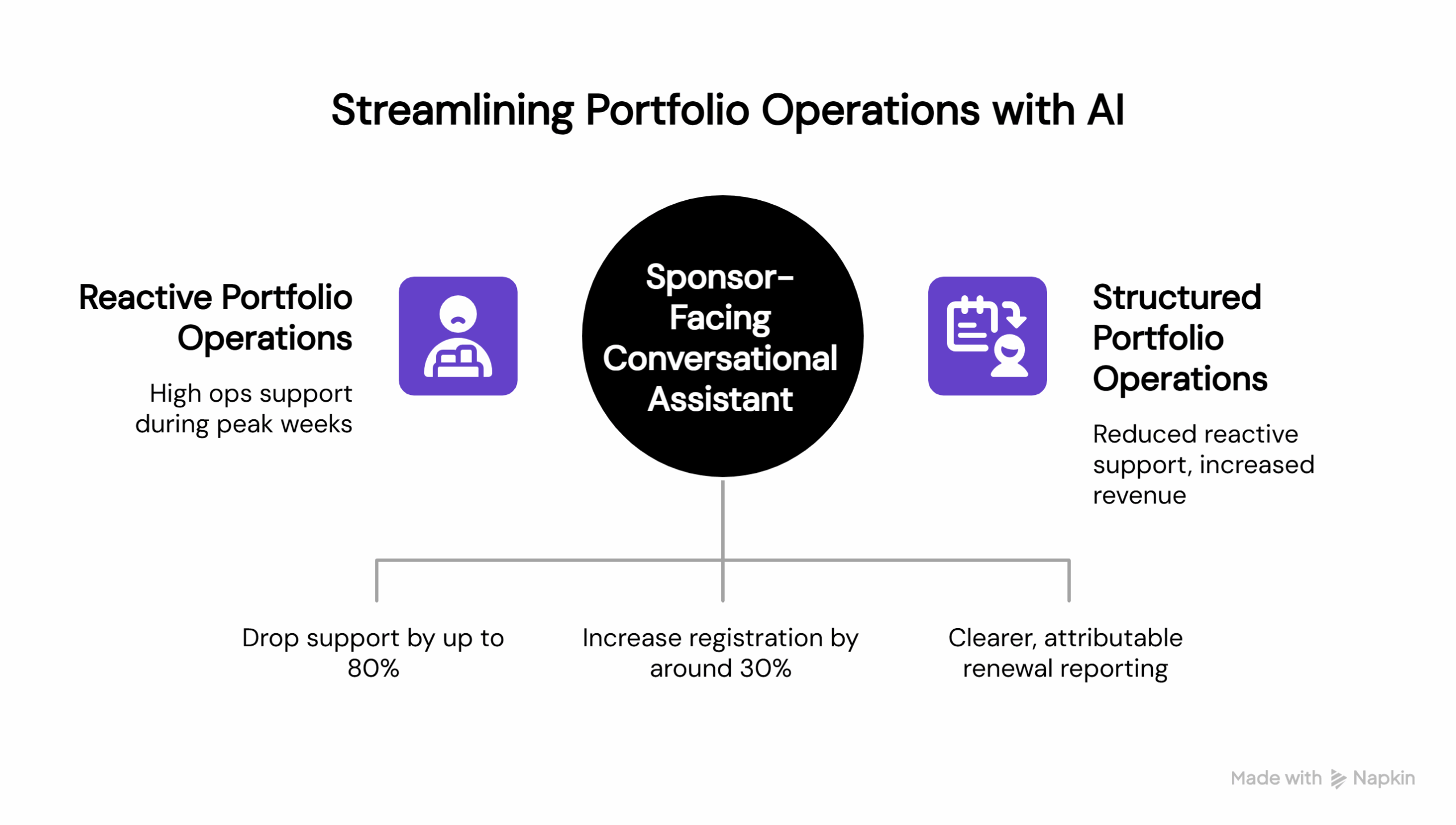
In portfolios using these playbooks through a sponsor-facing conversational assistant:
- Ops support can drop by up to 80 percent during peak weeks
- Registration and sponsor intent can increase by around 30 percent
- Revenue per sponsor can increase through clearer, attributable renewal reporting
These improvements don’t really come from ‘replacing’ people, but from structuring what was previously reactive.
Let’s build awards that improve every year
Strong awards programmes don’t just run a season. They convert intent into completed entries, defend sponsor value with proof, and get smarter every cycle.
That’s exactly what our Awards & Recognitions playbooks are designed to support.
If you want a practical view of what “AI-supported” actually means in an awards context, explore the playbooks and start with the workflow that matches your biggest pressure point right now:
- Reduce repetitive entrant questions without losing control of tone or guidance
- Improve entry completion and quality by catching confusion and drop-offs early
- Make sponsor value measurable by capturing high-intent moments and attributing outcomes
- Turn the season into a learning loop so next year isn’t built on guesswork and spreadsheets
The goal is simple… to run awards that convert, renew and get better every year.
Frequently asked questions on how to improve awards with AI?
Q1. How can AI improve an awards programme?
AI can improve an awards programme by reducing operational workload, guiding entrants toward higher-quality submissions, capturing sponsor intent signals, and structuring performance data into clear reporting. It supports consistency and speed while keeping editorial and judging decisions fully human-led.
Q2. What is AI used for in awards management?
In awards management, AI is typically used to answer repetitive entrant questions, detect drop-offs during the entry process, route high-intent behaviour toward sponsor products, and consolidate fragmented data into actionable insights. It improves execution across marketing, operations, and commercial workflows.
Q3. Can AI increase awards entry completion rates?
Yes. AI can increase entry completion rates by identifying stalled submissions, providing real-time guidance on category fit and eligibility, and sending behaviour-based reminders. When confusion decreases and support is immediate, more entrants complete their submissions.
Q4. How does AI improve sponsor ROI in awards programmes?
AI improves sponsor ROI by capturing high-intent interactions such as category exploration, nominee engagement, and voting activity, and linking them to sponsor-owned products. This allows awards teams to provide clearer, attributable reporting that supports renewal conversations.
Q5. Does AI replace judges in awards programmes?
No. AI does not replace judges or editorial decision-making. Judging remains fully human-led. AI supports operational efficiency, consistency, and data structure, but final decisions always remain with the judging panel.
Q6. How does AI help during peak awards season?
During peak weeks, AI can deflect repetitive queries across email, web chat, and messaging platforms, reducing strain on operations teams. It ensures entrants receive consistent, approved guidance without delays, which improves both entry quality and team capacity.
Q7. Can AI help with post-awards reporting?
Yes. AI can consolidate entries, engagement data, sponsor interactions, and revenue into a single structured view. This makes post-season reporting faster, clearer, and more defensible, while also helping teams benchmark performance year over year.
Q8. What are AI-native playbooks for awards teams?
AI-native playbooks are structured workflows that activate entrant intent, improve submission quality, maximise sponsor value, and turn seasonal data into repeatable insight. They focus on execution and adoption rather than abstract automation.