



If you run events, this scenario will likely feel very familiar.
Traffic appears healthy across your key acquisition channels, campaigns are consistently driving visitors to the website, agenda pages are attracting meaningful views, sponsor brochures are being downloaded, and registrations are coming through at a steady pace that suggests momentum is building.
And yet, when you sit down for a commercial performance review, there is an uncomfortable gap between activity and outcome.
Sponsor pipelines feel thinner than they should, given the visibility you’ve generated. Sales teams comment that the leads require additional qualification before they can meaningfully progress conversations. Your marketing team spends valuable time chasing enquiries that never convert into serious discussions. At the same time, analytics show visitors spending time on high-intent pages such as sponsorship packages, pricing tiers, or detailed agenda tracks, only to exit without submitting an enquiry or taking a clear next step.
The demand seems to be there. The engagement signals are visible. What is missing is clarity on intent, which makes it difficult to prove commercial value with confidence.
The root cause is not usually a lack of traffic or awareness. It is structural. Most event websites and digital ecosystems are built to present information rather than to capture and interpret intent while it is still forming.
Today’s event journey is rarely linear. It unfolds across multiple digital touchpoints: your website, email campaigns, paid media, social posts, event apps, sponsor landing pages, registration flows, messaging platforms, and customer support channels. Each interaction contains clues about what a visitor is trying to achieve. Someone reviewing sponsor packages is signalling something different from someone browsing speaker bios. A visitor comparing ticket categories has a different motivation from someone repeatedly returning to the agenda page.
However, in most setups, these touchpoints operate as static information repositories. They communicate details, but they do not actively qualify interest or structure those signals into actionable data. Visitors are left to self-navigate, interpret, and decide in isolation.
When prospective attendees or sponsors arrive, they are typically assessing a specific set of questions: Is this event aligned with my objectives? Does the audience match my target profile? Is the sponsorship package worth the investment? Will attending deliver tangible value? As they explore, unanswered questions accumulate. If those questions are not addressed quickly and clearly within the digital experience itself, hesitation sets in.
At that point, the simplest action is to leave, and this is where most event funnels quietly lose high-intent audiences.
What’s broken in the current model?
From what I see across event teams, the core issue is timing: qualification happens too late.
Most websites rely on generic forms like: ‘Register interest’, ‘Download brochure’, ‘Enquire now’. The form asks for name, company, job title, and email address. It captures contact details and absolutely ZERO context. You don’t know what that person is actually looking for, how urgent their interest is, or whether they are evaluating sponsorship or attendance.
This is how it plays out:
- The lead enters the CRM as a flat record.
- Your team has to infer intent through follow-up emails and calls.
- That takes time and creates friction.
- It also means you’re treating high-intent and low-intent prospects almost the same way.
At the same time, visitors who are still in evaluation mode rarely fill out those forms… instead, they browse the agenda, scan sponsor lists, check ticket tiers, compare dates.
They ask themselves: “Is the right event for my goals?”
If the website doesn’t guide them or address their specific concerns, they’ll say au revoir and bounce off.
You might see this in your analytics as well. You’ll see strong awareness at the top of the funnel, decent time on site, and then a sharp drop-off before enquiry or registration.
This is a classic qualification timing problem.
The current status quo in event growth
The standard flow looks like this (sorry, one last time):
- You drive traffic through paid media, email, and partnerships.
- Visitors land on your site and self-navigate.
- They move between the agenda, speaker pages, sponsor packages, and ticket information. If they feel confident enough, they fill in a generic form.
- Then your team manually qualifies them afterward.
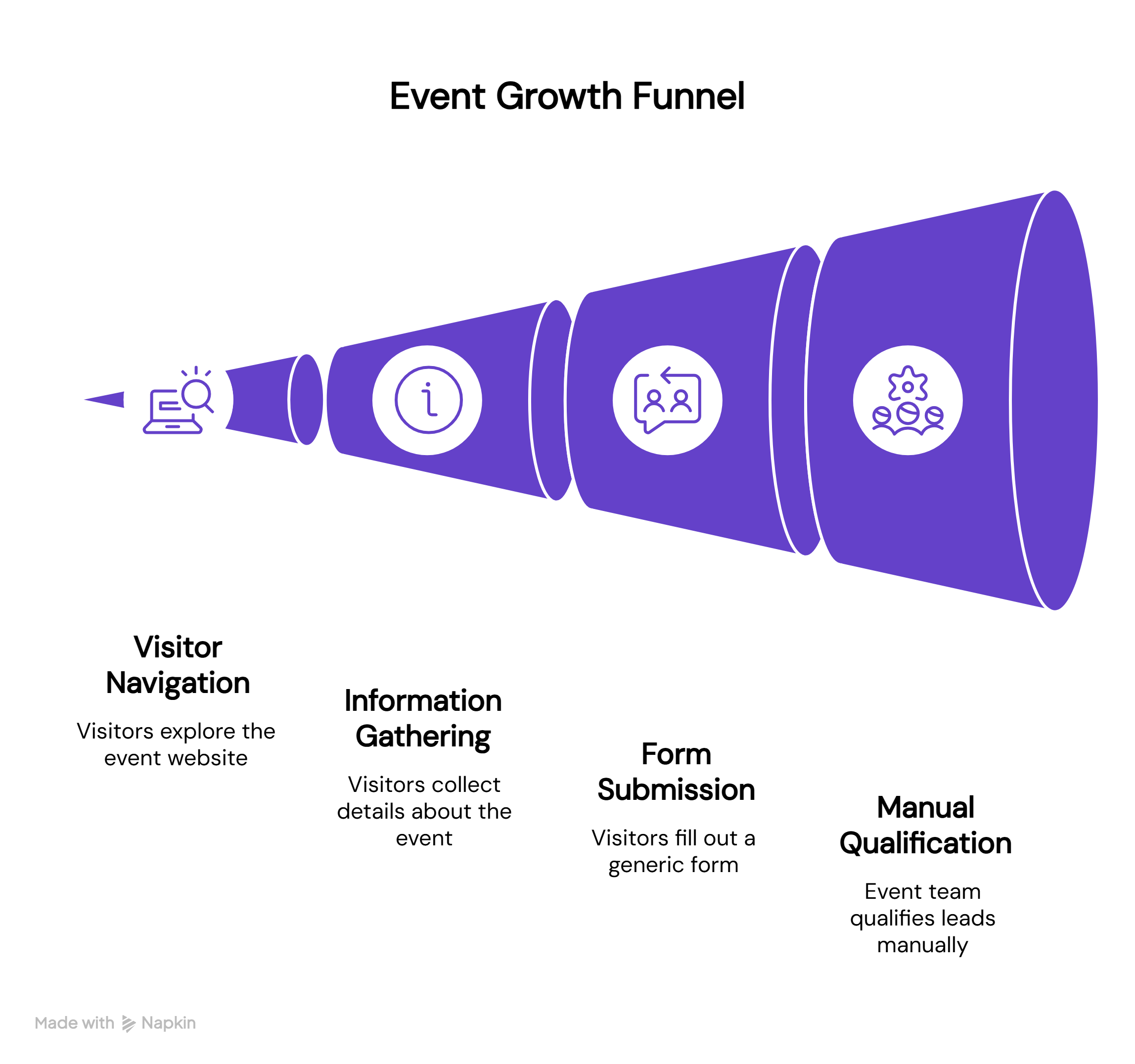
This reactive model creates leakage at several points.
- First, you lose anonymous visitors who were exploring seriously but had unanswered questions.
- Second, you capture contacts without knowing their true intent, which increases the sales workload (They’re already scoffing at you by now).
- Third, you struggle to prove sponsor ROI because the leads you pass along are not clearly segmented by interest or fit. (No surprise, sales stops inviting you for lunch breaks.)
Let’s take an example: Africa Tech Festival
Informa is a global events, intelligence, and academic publishing group with a portfolio that spans some of the world’s most influential industry gatherings. Africa Tech Festival is one of their flagship technology events, bringing together innovators, investors, founders, and industry leaders from across the African tech ecosystem.
At this scale, the digital experience carries significant commercial weight. It determines whether high-intent visitors stay long enough to meaningfully engage, whether sponsor interest is identified before it cools, and whether the event team can demonstrate clear, measurable value to commercial partners. When thousands of prospects are exploring at the same time, even small moments of friction or missed intent can compound into material revenue gaps.
Throughout this piece, we’ll return to Africa Tech Festival as a running example to show how a structural shift in qualification changes outcomes step by step, rather than as a one-off case study dropped in at the end.
In their case, awareness was strong, and traffic was healthy. However, visitors were not spending long enough on key commercial content, and anonymous browsing was not consistently translating into qualified prospects. The opportunity was not about attracting more visitors. It was about turning existing demand into structured, qualification-ready leads that the commercial team could act on with confidence.
The qualify-first shift
When I think about what actually changes performance, it’s this: qualification needs to move inside the browsing journey.
Instead of waiting for someone to complete a full form before you understand what they want, you capture structured intent signals as they explore.
That means embedding light, contextual prompts in high-intent moments.
For example:
- On a sponsorship page: clarify what type of partnership they are evaluating.
- On the agenda page: ask which themes or tracks matter most.
- On ticket pricing: understand whether they’re attending for networking, learning, or deal-making.
These prompts are short and aligned with the page context, requiring one or at most two clicks.
What you gain is zero-party data, explicit preferences that the visitor chooses to share. Now, when they submit an enquiry or register interest, you have context attached to that contact. You know why they are there.
Reducing friction at decision moments
There’s another layer to this; prospects hesitate because they still have unresolved questions.
Common blockers include (but are not limited to):
- “Is this audience aligned to my ICP?”
- “What exactly is included in this sponsor package?”
- “Who typically attends?”
- “How do I take the next step?”
If those questions require waiting for a human reply, you risk losing momentum.
A retrieval-grounded knowledge layer that uses organiser-approved content can answer these queries instantly and consistently. That keeps visitors moving rather than bouncing.
The combination of:
- Contextual qualification prompts
- Instant, accurate answers
creates a guided journey rather than a self-service maze.
Before and after: how the journey changes
In the old journey, someone browses, feels confused, and leaves. On the off-chance that they do submit a form, you try to decode their intent later.
In a quality-first journey, browsing triggers structured prompts. The visitor declares what they are looking for. Their questions are answered in real time using trusted event information. They are guided toward the most relevant next step, whether that is registering, booking a sponsor call, or exploring a specific track.
Before
- Anonymous browsing
- Generic forms
- Manual triage
- Low signal density
- Slower sponsor follow-up
After
- Interactive qualification
- Explicit preference capture
- Instant decision support
- Segmented leads
- Prioritised routing
Again, taking Africa Tech Festival as an example, the improvement was not the result of adding more traffic or increasing media spend. It came from changing how intent was captured and supported inside the journey.
Instead of allowing visitors to browse passively and then hoping they would complete a generic form, the team introduced contextual qualification prompts on high-intent pages. When someone explored sponsorship content, they were gently asked what type of partnership they were evaluating. When they reviewed agenda tracks or event themes, they were prompted to clarify their interests. These one- or two-click interactions converted browsing behaviour into structured zero-party data.
At the same time, decision-stage questions were resolved instantly using organiser-approved event information. Visitors no longer had to pause their journey to wait for an email response or search across multiple pages to find clarity. The digital experience actively reduced hesitation rather than amplifying it.
This dual approach, capturing explicit preferences early and removing friction at critical moments, reshaped how engagement translated into pipeline.
The measurable outcomes reflected that structural change:
- Visitors spent 2× longer on site, which increased exposure to high-intent content.
- Anonymous users were 10× more likely to return, suggesting stronger consideration and repeat evaluation.
- Lead capture increased from 0.25% to 2.7%, indicating that more of the existing demand was being converted rather than lost.
- 700 attendee leads and 30 sponsor leads were generated through guided interactions.
- On average, sales-qualified leads increased by 60%, as captured leads already contained intent signals.
- Lead-to-conversion rates rose by around 30%, supported by clearer routing and prioritisation.
These results were not driven by cosmetic engagement. They were the outcome of embedding qualification and decision support directly into the digital experience, so that interest was structured while it was still active.
Why does this matter for sponsor value and commercial performance?
From a sponsor perspective, relevance and intent are the goals (not volume).
Sponsors want leads that match their ICP, they want clarity on what attendees care about, AND they want to know that the prospects they meet have a genuine reason to engage.
When your capture system collects explicit preferences and intent signals, sponsor conversations change. You can route high-fit leads to the right commercial owners faster, prioritise follow-up based on declared interest rather than guesswork, and demonstrate that sponsor enquiries originated from structured, high-intent interactions.
This directly improves commercial performance, strengthening your ability to articulate ROI. It also reduces manual triage for your marketing and sales teams.
Importantly, this does not require overwhelming the visitor with pop-ups. The goal is not to add noise. The goal is to embed qualification naturally in the flow, aligned to where the visitor already is in their journey.
Making it practical for marketing teams
Event marketing leads are right to be cautious about adding complexity. The goal is not to overwhelm visitors with pop-ups or introduce fragile systems.
In practice, the Africa Tech Festival workflow was deployed through a no-code dashboard with a lightweight script installation.
Teams controlled:
- Placement and format
- Tone and UX
- Approved knowledge sources
- Safeguards and fallback handling
Behaviour was previewed and refined before going live.
This model keeps humans firmly in control of the commercial logic, the messaging, and the standards that define the event.
AI supports qualification and routing at scale, but it does not decide strategy. Teams define what “high intent” actually means for their event. They determine which signals matter, which segments require priority follow-up, and how sponsor or attendee pathways should be structured. The system executes against those rules, but the judgment remains human.
That matters for two reasons:
- Events are commercially sensitive environments. Sponsorship positioning, pricing nuances, audience claims, and partnership conversations require accuracy and consistency. Humans step in when new information needs to be added, when messaging shifts, or when a response requires context beyond structured content. They refine prompts, update approved knowledge sources, and adjust qualification criteria as the event evolves. This prevents automation from drifting away from commercial reality.
- Intent is almost never static. As campaigns launch, themes shift, and certain tracks gain traction, teams can review interaction data and see where signals are strengthening or weakening. Humans analyse those patterns and decide how to respond. They may tighten a qualification question, prioritise a different segment, or introduce new routing logic for high-value prospects. AI processes the volume, but people interpret the meaning and steer the direction.
In practical terms, humans step in at three key moments:
- Configuration: Defining what gets asked, how intent is categorised, and where routing flows lead.
- Oversight: Reviewing outputs, ensuring accuracy, and updating knowledge when event details change.
- Optimisation: Analysing interaction data and refining qualification criteria based on real-world commercial outcomes.
Keeping that human layer active ensures that automation strengthens commercial performance rather than operating independently of it. AI handles the scale and speed of interaction. Teams retain ownership of strategy, brand integrity, and revenue priorities.
A practical playbook you can apply
If you want to experiment with this approach, I’d suggest starting here:
- Map decision blockers
List the most common questions sponsors and attendees ask before converting. - Identify high-intent pages
Focus on agenda, ticket pricing, sponsor packages, exhibitor listings. - Insert contextual prompts
Keep them short. Align them with page context. Capture one or two key signals. - Store preferences as structured data
Attach declared interests to each captured lead. - Route based on intent strength
Ensure high-value sponsor prospects are prioritised immediately. - Track signal density, not just traffic
Measure return rate, time on high-intent pages, proportion of leads with declared preferences, and lead-to-conversion rates.
When you do this, you often realise the issue was never a demand, it was timing and structure.
The future of event growth is qualification-first
Events operate in compressed timelines. Decisions are often made across multiple sessions. Committees evaluate sponsorship options carefully. Attendees compare several events before registering.
In that environment, waiting until after capture to understand intent is inefficient.
A quality-first, AI-native playbook turns every digital touchpoint into a light qualification layer. It captures explicit signals early. It resolves friction instantly. It routes intelligently. It compounds insight over time.
If you are reviewing your event funnel this year, ask yourself a simple question. At what point do you truly understand why a visitor is there?
If the answer is “after they fill out a generic form,” there is room to redesign the journey.
If you’d like to pressure-test your current setup, share your top traffic sources, your lead capture rate, and where sponsor enquiries typically drop off. We’re happy to send back a tailored qualify-first playbook outline based on your event model.
Frequently asked questions
Q1. What are high-intent event audiences?
High-intent event audiences are visitors who are actively evaluating attendance or sponsorship, rather than casually browsing. They typically spend time on agenda pages, sponsor packages, pricing tiers, or exhibitor listings. Their behaviour signals consideration. The challenge is that most event websites capture very little of that intent before visitors leave.
Q2. Why do event websites lose high-intent visitors?
Most event websites are built to present information, not to structure intent. Visitors explore independently, accumulate unanswered questions, and leave if clarity does not arrive quickly enough. When qualification only happens after someone fills out a generic form, a large share of serious prospects remain anonymous.
Q3. What is a qualify-first event growth strategy?
A qualify-first strategy captures intent during the browsing journey rather than after form submission. It uses contextual prompts on high-intent pages to collect explicit preferences, such as sponsorship goals or thematic interests. These signals are stored as structured data, allowing teams to segment and prioritise leads more effectively.
Q4. How is this different from adding more forms or pop-ups?
The goal is not to increase friction. A qualify-first model introduces short, contextual interactions aligned to where the visitor already is in their journey. Instead of interrupting the experience, it clarifies intent in one or two clicks. This creates signal without overwhelming the user.
Q5. What is zero-party data in events?
Zero-party data refers to information that visitors intentionally and proactively share about their preferences, priorities, or intent. In an event setting, this might include the type of sponsorship they are exploring, the themes they care about, or their reason for attending. Unlike inferred behaviour, zero-party data provides explicit context that strengthens qualification.
Q6. How does this improve sponsor ROI?
Sponsors care about relevance and fit. When attendee or sponsor enquiries include declared interests and intent signals, commercial teams can route leads more intelligently and prioritise follow-up based on alignment. This strengthens conversion conditions and makes ROI conversations more concrete.
Q7. Does this replace human sales or marketing teams?
No. A qualify-first model supports teams by handling structured qualification and instant decision support at scale. Humans define what high intent means, refine qualification logic, oversee accuracy, and adjust strategy as campaigns evolve. AI processes volume and speed, while teams retain control over commercial judgement and brand standards.
Q8. How quickly can this type of model be implemented?
In the Africa Tech Festival example referenced above, the workflow was deployed through a lightweight script and a no-code dashboard configuration. The shift did not require a full website rebuild. It focused on inserting qualification and decision support layers into existing high-intent pages.
Q9. What metrics should event teams track to measure success?
Instead of focusing only on traffic, teams should monitor:
- Time spent on high-intent pages
- Return visitor rates
- Lead capture rate improvements
- Percentage of leads with declared preferences
- Sales-qualified lead volume
- Lead-to-conversion rates
These indicators reflect signal density and qualification quality, not just activity.
Q10. Is this relevant only for large-scale events?
No. While large portfolio events see compounding benefits due to higher traffic volumes, mid-sized and niche events often benefit even more from structured qualification. When pipelines are smaller, improving signal quality and reducing leakage directly impact commercial outcomes.