



Sponsor renewals are becoming harder, even when events perform well.
Most event formats in 2025 delivered strong attendance. Sessions were full, booth traffic looked healthy, and post-event reports showed high engagement. On the surface, everything appears to be working.
Yet renewal conversations tell a completely different story.
Sponsors hesitate, budgets are questioned, finance teams ask for more justification, and, of course, commercial teams are pushed to explain value rather than reinforce it.
This tension is becoming common in 2026: sponsor ROI stories break because they lean on vague engagement and non-attributable inventory that finance teams don’t trust.
Most sponsor ROI narratives rely on vague engagement signals. These signals may sound positive but fail to hold up when budgets, renewals, and procurement decisions are reviewed internally. As a result, sponsorship performance feels harder to defend year after year.
This article explains why sponsor ROI stories are breaking, what metrics are losing credibility, and how event teams can rebuild renewal confidence before the next renewal season.
TL;DR
- Sponsor ROI stories are breaking in 2026 because they rely on vague engagement metrics that finance teams no longer trust
- Metrics like impressions, footfall, and generic engagement describe activity but fail to prove sponsor-owned value
- Strong sponsor ROI stories focus on sponsor-owned moments that are attributable, measurable, and repeatable
- High-performing sponsorship measurement prioritises audience quality, intent signals, and action-based outcomes
- Event teams in 2026 are selling outcome-driven sponsor products rather than bundled exposure
- When ROI stories are clear and defensible, sponsor renewals shift from negotiation to continuation
What’s really breaking in sponsor ROI stories
Sponsor ROIs almost always fail after the event (not during it).
Events still generate activity, attendees move through exhibition halls, you hear chatter about exhibits, sponsors interact with visitors, apps record clicks, and scans and sessions attract large audiences. But ROI? Feels missing.
The problem appears when this activity is translated into value (or not?!)
Terms like ‘great visibility’ and ‘high interaction’ are often used to describe sponsor performance. And while these phrases are easy to understand, they’re super hard to validate in terms of ROI. That’s because they don’t show ownership, outcomes, or even impact.
By 2026, many sponsors will face greater internal scrutiny as finance teams demand evidence that sponsorship spend led to measurable progress. And commercial teams are expected to show results that can be compared and repeated.
When sponsor ROI can’t answer these questions clearly, renewals become fragile.
The current sponsor reporting approach creates renewal risk
Most sponsor reports still follow a predictable format.
They highlight impressions, estimated footfall, booth traffic, session attendance, and app engagement. Some include survey feedback or brand recall scores. On the surface, these reports look full and positive. They show activity. They show movement. They show reach.
What they do not consistently show is defensible value.
The underlying issues are structural.
- Sponsors don’t clearly own the experience being measured, which makes their investment feel shared and interchangeable rather than distinct and defensible. If multiple sponsors appear within the same engagement environment, the value becomes blurred.
- Engagement is aggregated rather than attributed, which prevents sponsors from isolating their actual contribution. When activity is reported at the event level rather than the sponsor level, it becomes difficult to prove the specific impact driven by their presence.
- Outcomes are implied instead of demonstrated, which increases perceived risk. When reports rely on interpretation, sponsors struggle to defend spending internally, and procurement teams begin asking harder questions.
This is where renewal risk quietly builds.
Engagement metrics explain what happened. They do not clearly show what changed, what progressed, or what moved closer to revenue. As finance teams become more involved in sponsorship approvals, they look for signals that connect spend to measurable advancement.
During renewal reviews, the same questions surface repeatedly:
- What did this sponsor receive that others did not?
- Which actions were directly attributable to this partnership?
- What evidence shows intent, progression, or commercial movement?
- Can this performance be compared year over year?
When sponsor ROI depends on narrative interpretation rather than clear attribution, the burden of proof shifts onto the commercial team. At that point, renewal conversations become defensive instead of confident.
Metrics sponsors trust in 2026
Stronger sponsor ROI stories focus on signals that show who was reached, how they engaged, and what changed.
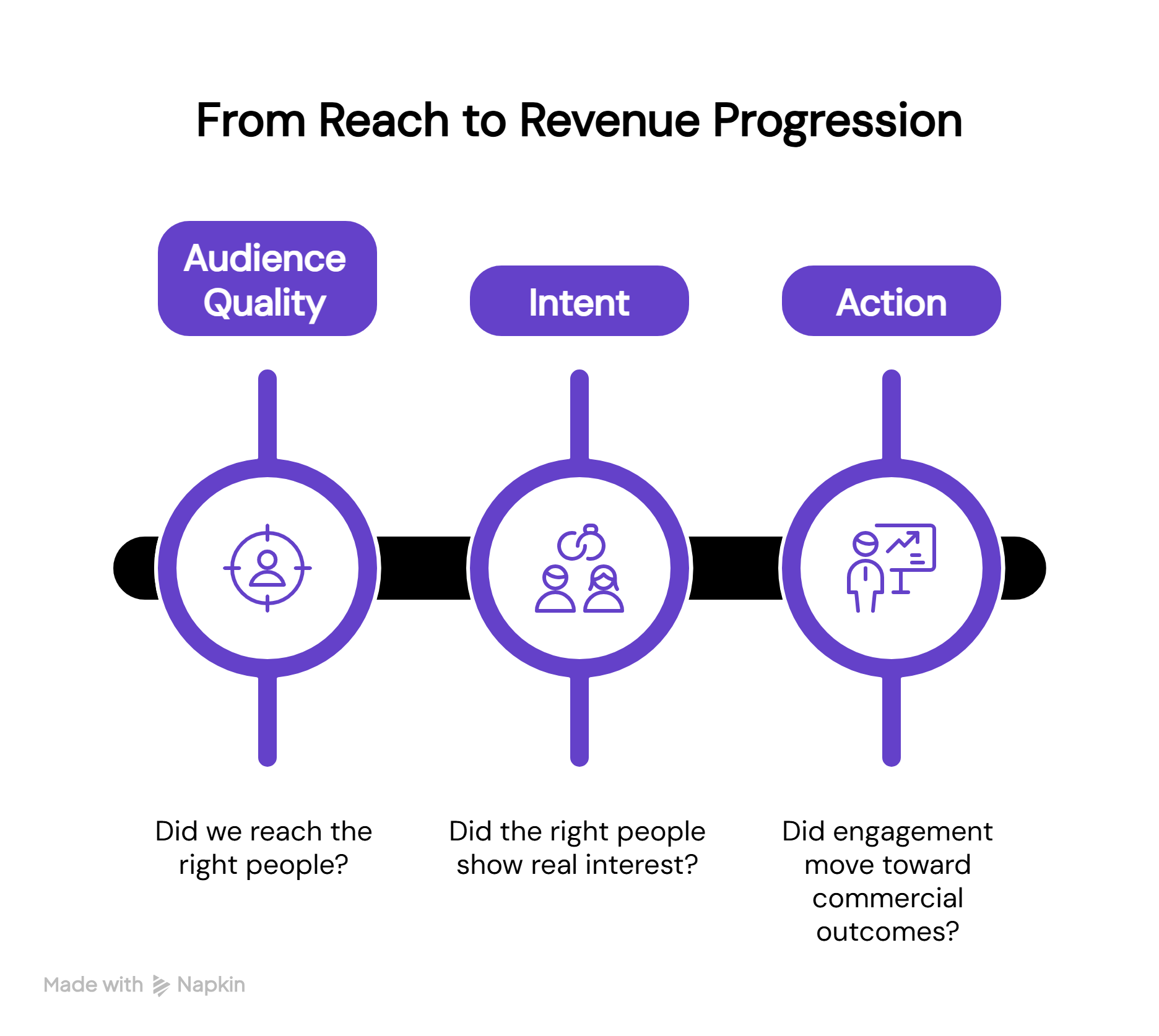
These signals fall into the following categories:
-
Audience quality signals
Audience quality is more meaningful than raw volume during renewal discussions and indicates whether sponsors reached the right people (or not).
- Job roles and functions
- Seniority levels
- Industry alignment
- Buying influence
-
Intent signals
These show interest beyond casual engagement and help sponsors explain why some interactions mattered a little more than others.
- Questions asked
- Content accessed
- Comparisons explored
- Follow-up requests
-
Action signals
Action signals anchor sponsor ROI in measurable progress and show movement toward commercial outcomes.
- Meetings booked
- Introductions facilitated
- Leads qualified against agreed criteria
- Demos requested
When these signals are reported clearly, the tone of the renewal conversation changes.
Instead of talking about visibility or general engagement, sponsors can talk about qualified reach, buyer intent, and commercial progression. They can point to who they met, what those people did, and how those interactions moved closer to pipeline or revenue.
This is the language internal budget holders recognise (and smile at). Finance and procurement teams evaluate spend based on risk, return, and forward potential. When sponsor reporting aligns with those same dimensions, the discussion is easier to defend. Perceived risk decreases, internal approval feels more grounded, and renewal decisions move forward with greater confidence.
Sponsor-owned moments improve renewal confidence
Sponsor ROI becomes easier to defend when sponsors can point to moments they clearly owned, rather than generic exposure.
A sponsor-owned moment is a defined interaction or experience that is:
- Clearly associated with the sponsor
- Measurable and attributable
- Relevant to attendee intent or decision-making
Examples include guided discovery experiences, facilitated meetings, sponsor-led knowledge interactions, or structured follow-up pathways.
These moments allow sponsors to answer internal questions with confidence, providing clarity during budget reviews and reducing friction during renewals.
Sponsor products event teams can defend in 2026
Sponsors increasingly expect defined products instead of bundled exposure. They want to understand what they are buying, how it works, and how it contributes to their goals.
High-performing sponsorship products focus on outcomes that sponsors can explain internally.
In 2026, these products usually fall into three structured categories:
-
Access-driven sponsor products
These products are designed to get sponsors in front of the right people in a structured and measurable way.
They focus on controlled access rather than open visibility. The goal is to reduce randomness and increase relevance.
Examples include:
- Curated introductions between sponsors and attendees who match agreed criteria
- Role-based discovery tools that connect decision-makers with relevant sponsors
- Qualified meeting pathways where attendees can book structured conversations
These products answer important sponsor questions:
- Did we reach the right roles and companies?
- Were we introduced to decision-makers or just general attendees?
- How many structured conversations were created because of this sponsorship?
Access-driven products are easier to defend because they link sponsorship to defined interactions.
-
Decision-driven sponsor products
These products focus on helping attendees think through decisions inside a sponsor-owned environment.
They are built around knowledge, comparison, and guided exploration. Instead of broad exposure, they position the sponsor as part of a decision journey.
Examples include:
- Guided exploration tools that surface relevant sponsor solutions
- Sponsor-backed knowledge hubs or insight experiences
- Structured comparison support where attendees evaluate options
These products answer a different set of questions:
- Did attendees engage with our expertise?
- Were we present at the point where evaluation or comparison happened?
- Did we influence how buyers understood their options?
Decision-driven products are powerful because they connect sponsorship to influence and positioning rather than passive awareness.
-
Continuation-driven sponsor products
These products are designed to keep high-intent conversations moving after the event.
They recognise that commercial outcomes rarely happen on the event floor. Instead, they focus on sustaining momentum.
Examples include:
- Post-event engagement pathways linked to sponsor interactions
- Follow-up journeys based on intent signals
- Retargetable audiences built from defined high-intent behaviour
These products answer questions that matter most during renewal discussions:
- What happened after the event ended?
- Did conversations continue?
- Was there measurable progression toward pipeline?
Continuation-driven products strengthen sponsor ROI because they show forward movement, not just event-day activity.
When sponsorship products are structured around access, decision support, and continuation, pricing discussions become clearer. Sponsors can describe what they purchased in simple terms. They can connect it to audience quality, intent, and progression. That clarity makes renewal conversations steadier and easier to justify internally.
How to actually run the sponsor products you sell
Defining access, decision, and continuation products is one step, but running them consistently is a different ballgame altogether.
Most organisers struggle with the actual execution. Each edition of an event often depends on manual coordination… teams connect data points by hand (okay, not literally, but you get it), conversations are passed between systems, and signals are noticed, but not always acted on.
This is where friction starts building up.
Attendees typically search the app, browse the website, ask questions over email or WhatsApp, and revisit certain sessions or topics. Now, these actions show interest, yet many of those signals go nowhere. Only a small percentage turn into sponsor conversations, and many disappear without follow-up.
When renewal season arrives, organisers struggle to show how sponsored products actually performed. The intention is always strong, but the execution remains inconsistent
The Sponsor Maximisation Playbook is designed to close that gap. Here’s how it works:
At a simple level, it defines what should happen when someone shows intent. It then uses agentic workflows to ensure actions occur automatically and consistently. This often includes a digital conversational assistant powered by AI. The assistant operates in the channels attendees already use, such as WhatsApp, email, the event app, or the website. It guides attendees to the sponsor products that have already been sold.
- Before the event: The playbook focuses on visible intent signals. These include what attendees select during registration, the topics they explore, and the sessions they return to. Instead of sitting on a dashboard, these signals trigger invitations into sponsor-owned journeys. That may include structured introductions, curated discovery experiences, or meeting pathways aligned with sponsor products.
- During the live event: The same logic continues to apply. When an attendee searches for a topic, asks a question, or spends time engaging with a theme, the assistant can suggest relevant sponsors, sessions, or offers. Each interaction is linked to a specific sponsor product. Each action is recorded as part of a sponsor-owned moment.
- After the event: Attention shifts to follow-up. The focus is on attendees who have already shown clear intent. Because interactions were captured in real time, reporting becomes structured and attributable. Organisers can show which experiences each sponsor owned, who engaged, what actions followed, and how those actions contributed to ongoing conversations.
Over one or two cycles, this changes the sponsor narrative.
Instead of saying, “we had strong visibility”, sponsors can say, “we owned defined experiences, reached specific roles, and saw measurable progression.” That is language that commercial leaders and finance teams understand and support.
Across portfolios using the Sponsor Maximisation Playbook, delivered through a sponsor-facing conversational assistant, the impact is measurable. Organisers typically see 15-50% more revenue per sponsor from pre-event products. They see 20-45% more sponsor meetings during the event. Rebooking rates increase by 10 to 25 percent due to clearer and attributable reporting.
Basically, this is all about structuring sponsor products so they run predictably, capture intent, and produce reporting that supports renewal decisions.
If you’re curious how Bridged’s Sponsor Maximisation Playbook can power sponsor yield and renewal confidence, this is the place to start.
A checklist for sponsorship teams heading into 2026
Use this as a quick audit before renewal season:
- Can each sponsor clearly explain what they owned?
- Can ROI be understood without verbal explanation?
- Can finance teams defend the spend internally?
- Can the same story be reused next year?
- Do core reports lead with audience quality, intent and actions?
If these answers are unclear, the sponsor ROI story is at risk.
Fixing it before renewal season creates confidence, clarity, and commercial stability.
FAQs for why sponsor ROI stories break in 2026
Q. Why are sponsor ROI stories breaking in 2026?
Sponsor ROI stories are breaking because they rely on engagement metrics such as impressions and visibility that cannot be clearly attributed or defended during budget and renewal reviews.
Q. What metrics do sponsors trust in 2026?
Sponsors trust metrics that show audience quality, intent, and action, including role relevance, questions asked, meetings booked, and qualified leads.
Q. What is a sponsor-owned moment?
A sponsor-owned moment is a defined interaction or experience that the sponsor clearly owns and can measure, such as guided discovery, facilitated meetings, or knowledge-based interactions.
Q. Why do finance teams question engagement metrics?
Finance teams question engagement metrics because they describe activity but do not demonstrate outcomes, attribution, or repeatable value.
Q. How can event teams improve sponsorship renewals?
Event teams can improve renewals by shifting from reporting activity to proving sponsor-owned outcomes and presenting ROI in a clear, reusable narrative.
Q. What should event teams stop reporting to sponsors?
Event teams should reduce over-reporting of impressions, estimated footfall, generic engagement scores, and unqualified app interactions.
Q. What sponsor products perform best in 2026?
Sponsor products that perform best focus on access, decision support, and continuation, including curated introductions, guided discovery, and post-event engagement paths.
Q. How should sponsor ROI be presented for renewal season?
Sponsor ROI should be presented using a simple structure that explains what the sponsor owned, who engaged, what actions occurred, and what outcomes followed.
Q. Why do clearer ROI stories reduce pricing pressure?
Clear ROI stories reduce pricing pressure because they lower perceived risk and make sponsorship value easier to justify internally.
Q. When should sponsorship teams fix their ROI narrative?
Sponsorship teams should fix their ROI narrative before renewal season, not during negotiations, to maintain leverage and confidence.