



5 sponsorship myths that are killing renewals
At Confex this year, we hosted a roundtable with ten event leaders running exhibitions, conferences, and awards portfolios.
The conversation quickly converged on a problem that many organisers experience:
Sponsor renewals are becoming harder to secure, but not because events are failing to attract audiences or sponsors. Most organisers in the room reported strong attendance, solid sponsor demand, and healthy commercial pipelines. I believe the real challenge lies somewhere else.
Proving sponsor ROI in a way that protects renewals has become increasingly difficult.
Sponsors often leave events feeling positive about the experience. They remember strong conversations, promising meetings, and moments where they connected with the right audience. Yet when they return to their organisations and attempt to explain the value internally, the story often becomes harder to repeat.
The reports they receive from events usually contain impressive numbers. Badge scans, impressions, session attendance, and engagement metrics all look convincing at first glance. However, these metrics rarely answer the question that matters most inside a sponsor organisation, it’s this one:
Did the event create meaningful commercial impact?
Several organisers at the roundtable described what happens next as the ‘internal fizzle.’ The sponsor’s excitement fades because the value narrative cannot be clearly explained to leadership teams who expect evidence of real opportunities or buyer interest.
Most events already capture valuable engagement signals through registration answers, agenda engagement, exhibitor discovery tools, and meeting interactions. The challenge is that these signals remain fragmented across systems, which makes it difficult to turn them into a narrative that sponsors can confidently explain internally.
When that clarity is missing, renewal conversations begin to rely on intuition rather than evidence.
Across the discussion, five common industry myths emerged that undermine sponsor renewals.
TL;DR
- Sponsor renewals usually fail because sponsors cannot clearly prove ROI internally, even when the event created meaningful engagement.
- Most sponsorship reports rely on impressions, scans, and lead counts, which show activity but rarely demonstrate commercial impact.
- The signals needed to prove sponsor value already exist across registration data, agenda engagement, meetings, and exhibitor discovery, but they are often fragmented across systems.
- When sponsors cannot explain the value story internally, enthusiasm fades, and renewal momentum disappears, a pattern organisers described as the “internal fizzle.”
- Renewals improve when organisers focus on qualified interactions, buyer-intent signals, and meaningful conversations rather than generic engagement metrics.
- The strongest sponsorship programmes align sponsor goals early, connect engagement signals across the event lifecycle, and track outcomes that sponsors can confidently present to leadership.
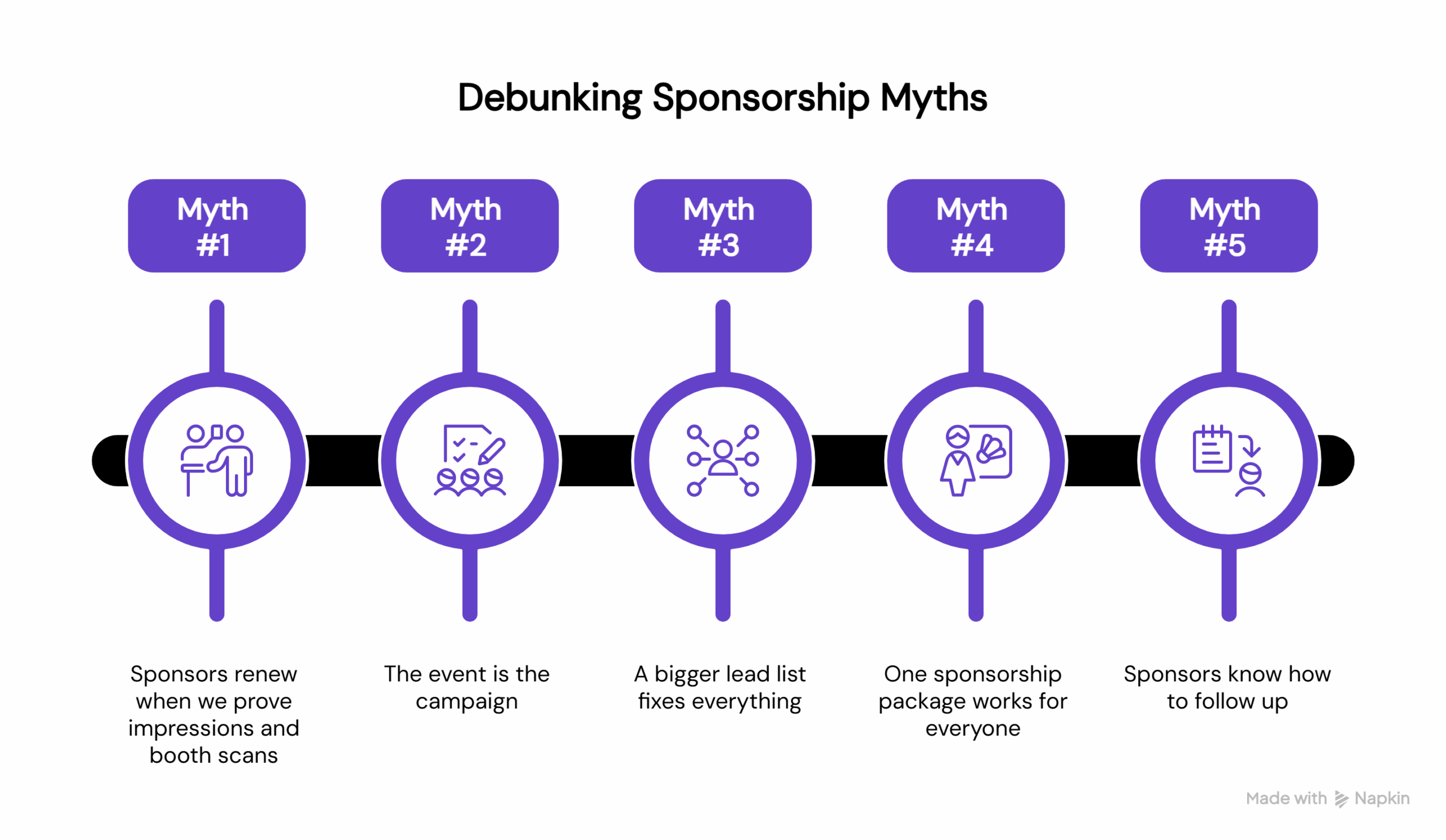
Myth #1: Sponsors renew when we prove impressions and booth scans
One of the most persistent myths in the events industry is that sponsors renew primarily when organisers demonstrate reach. As a result, many sponsorship reports begin with metrics such as booth scans, impressions, session attendance, and app interactions, because these numbers are easy to collect and visually reassuring to present.
However, the real challenge emerges once the sponsor returns to their own organisation and attempts to explain the event’s impact to leadership.
A marketing or commercial leader rarely asks how many people walked past the booth or how many impressions the event generated. Instead, the conversation quickly shifts toward business outcomes. Leadership teams want to understand whether the event helped the company reach relevant buyers, whether conversations progressed toward real opportunities, and whether those interactions had the potential to influence pipeline.
This is where many sponsorship reports struggle to hold up: the metrics organisers provide tend to describe activity rather than buyer behaviour, making it difficult for sponsors to connect those numbers to commercial results. Sponsors may remember strong conversations or promising introductions, yet when they attempt to translate those experiences into a narrative that can be repeated internally, the story often becomes fragmented.
The fact is…
The signals need to prove that sponsor value already exists, but they are scattered across different systems and rarely connected into a single narrative. Engagement signals live across registration answers, agenda exploration, exhibitor discovery tools, meeting requests, and session participation, yet they remain fragmented across the event stack.
Sponsors may leave the event feeling positive about their interactions, but when they attempt to repeat the story internally, the absence of a clear narrative causes the momentum to disappear.
When organisers begin connecting these signals into a coherent account-level story, the renewal conversation changes dramatically. Sponsors can show which companies interacted with them repeatedly, how those interactions evolved across the event journey, and which behaviours suggested genuine buying interest.
Instead of presenting isolated activity metrics, they are able to demonstrate that specific buyers actively explored their category.
Myth #2: The event is the campaign
Another assumption that shapes sponsorship strategies is the myth that the event itself represents the central marketing moment. Many organisers concentrate sponsorship value into the days when the exhibition floor is open, and the audience is physically present, which naturally places booth traffic, stage appearances, and networking events at the centre of the sponsorship experience.
However, buyers rarely follow such a compressed timeline.
Sponsors often view events as part of a longer commercial journey that begins well before the event takes place and continues long after it ends. Buyers may start researching topics through event content months in advance, explore sponsors while reviewing the agenda, and continue conversations with vendors weeks after the event has concluded.
When organisers treat the event as the entire campaign, a significant portion of the value created around the event remains invisible.
The fact is…
Organisers and sponsors often operate on different timelines when evaluating ROI. Organisers frequently consider the event the culmination of the sponsorship experience, while sponsors tend to evaluate value over a longer period that includes the follow-up conversations that happen months later.
This misalignment means that many sponsorship reports capture only a fraction of the interactions that ultimately influence commercial outcomes.
When organisers expand their perspective and track engagement signals across the entire lifecycle surrounding the event, the value story becomes far more compelling. Sponsors can demonstrate how buyers discovered their brand before the event, interacted with their content during the event, and continued meaningful conversations afterward.
The event becomes one moment in a larger commercial cycle rather than an isolated marketing activity.
Myth #3: A bigger lead list fixes everything
For many years, sponsorship success has been associated with lead volume. The assumption is simple: if sponsors leave the event with a long list of contacts, the event must have delivered value. As a result, organisers often emphasise the total number of badge scans or leads collected as a central indicator of performance.
In practice, large lead lists frequently create the opposite effect.
Sponsors often discover that a significant portion of the contacts they collected are not relevant to their commercial priorities. Some attendees may have visited the booth casually, others may not hold decision-making roles, and many may not have genuine interest in the sponsor’s solutions.
The process of qualifying hundreds of contacts can quickly reveal that only a small percentage represent meaningful opportunities.
The fact is…
Over-promising lead volume often leads to uncomfortable renewal conversations, particularly when sponsors realise that many of the leads they received cannot realistically convert into opportunities.
organisers are very effective at delivering audiences, but they are often less effective at delivering or tracking meaningful connections between those audiences and sponsors.
Sponsors increasingly value signals that demonstrate deeper engagement rather than raw contact numbers. Indicators such as meetings with decision-makers, repeated interactions from the same organisation, or sustained engagement with relevant content provide much stronger evidence of commercial interest.
When organisers shift the focus from lead volume to connection quality, sponsors are far better equipped to explain the event’s value internally.
Myth #4: One sponsorship package works for everyone
Standardised sponsorship packages have long been the backbone of event monetisation. Bronze, Silver, and Gold tiers provide clear pricing structures and make sponsorship easier to sell, which explains why this model remains widely used across exhibitions and conferences.
However, this structure assumes that every sponsor enters the event with the same objectives.
In reality, sponsors participate in events for very different reasons. One organisation may be focused on generating pipeline within a specific sector, another may want to position itself as a category authority, and a third may be trying to secure conversations with a handful of strategic accounts.
When these diverse objectives are placed into identical sponsorship structures, the resulting outcomes often feel generic.
The fact is…
When sponsorship packages are designed around standard deliverables rather than sponsor goals, the perceived value of the investment often declines.
Organisers may successfully deliver the promised inventory, such as booth space, branding exposure, or stage time, but sponsors can still struggle to explain how those deliverables translated into meaningful commercial outcomes.
Sponsors respond far more positively when sponsorship opportunities are designed around specific goals. When organisers begin by understanding what the sponsor wants to achieve and then shape the sponsorship around that objective, the resulting engagement becomes far more relevant.
This shift transforms sponsorship from a generic package into a strategic collaboration.
Myth #5: Sponsors know how to follow up
Another assumption that influences sponsorship strategy is the myth that the organiser’s responsibility ends once the event has delivered leads or engagement opportunities. Many organisers assume that sponsors already have established processes for qualifying leads, prioritising follow-up, and converting conversations into opportunities.
In reality, this assumption often proves incorrect.
Sponsors frequently leave events with large volumes of data but little clarity about which signals deserve immediate attention. Without guidance, sales teams may struggle to determine which contacts represent genuine buying interest and which interactions were purely exploratory.
As a result, many promising conversations never progress beyond the initial interaction.
The fact is…
A significant education gap between organisers and sponsors, particularly when it comes to post-event follow-up. Many sponsors simply need help interpreting the engagement signals generated during the event and understanding which leads should be prioritised.
When organisers help sponsors interpret those signals and identify high-intent accounts, sponsors are far more likely to convert event engagement into real opportunities.
Helping sponsors succeed after the event ultimately strengthens the value story that sponsors must present internally. And that story is what protects renewals.
The sponsor renewal reset
Sponsor renewals improve when organisers move away from fragmented activity metrics and toward a structure that makes outcomes visible.
This shift requires three changes.
- Outcome alignment: define what success looks like for the sponsor before the event begins.
- Intent orchestration: connect engagement signals across registration, content, meetings, and discovery tools.
- Lifecycle value: extend sponsor engagement across the entire event cycle rather than concentrating value into a few days.
When these elements are in place, sponsor ROI becomes far easier to explain internally. The clarity gap disappears, and renewals follow.
How does the Sponsor Maximisation Playbook help?
Many organisers already collect valuable engagement signals across their events, and the challenge lies in turning those signals into sponsor value.
The Sponsor Maximisation Playbook focuses on converting buyer intent into measurable sponsor outcomes.
Once intent signals become visible, the playbook enables teams to:
- Identify buyers actively exploring solutions
- Surface the next best sponsor action
- Route interested buyers toward relevant sponsors
- Enable meaningful conversations between buyers and partners
- Produce credible proof of sponsor impact
Instead of passive brand exposure, sponsors engage buyers who have already demonstrated interest. Conversations replace impressions, and value is documented during the event rather than debated afterward.
Trusted by leading event portfolios, this approach helps organisers increase sponsor yield while creating stronger renewal conversations.
If you want to explore how this works in practice, download the Sponsor Maximisation Playbook one-pager to see what the playbook enables for your team and how it can improve sponsor yield performance.
In a nutshell
If you want to understand where sponsor renewals might be slipping through the clarity gap, our team can help.
We can review your current sponsor workflow, identify where intent signals are being lost, and show how those signals can become clearer proof of sponsor value.
If you are looking for a scalable way to connect fragmented data and protect sponsor renewals across your portfolio, get in touch with our team.
FAQs for 5 Sponsorship Myths
Q1. Why do sponsors decide not to renew event sponsorships?
Sponsors often decide not to renew when they cannot clearly demonstrate ROI inside their organisation. Even if the event delivered strong engagement, sponsors may struggle to explain the commercial impact to leadership teams when reporting focuses mainly on impressions, booth scans, or general engagement metrics.
Q2. What metrics actually matter when proving event sponsor ROI?
Sponsors increasingly care about metrics that demonstrate meaningful engagement rather than reach. Indicators such as qualified meetings, repeated engagement from specific companies, buyer interactions with relevant content, and follow-up conversations after the event provide stronger evidence of commercial value than impressions or lead counts alone.
Q3. Why are impressions and booth scans not enough to prove sponsor value?
Impressions and booth scans measure activity, but they do not show whether buyers were genuinely interested in a sponsor’s solutions. Leadership teams typically expect evidence that the event influenced pipeline, created meaningful conversations, or connected sponsors with relevant decision-makers.
Q3. How can event organisers improve sponsor renewal rates?
Organisers can improve renewals by defining sponsor outcomes before the event, capturing intent signals throughout the event journey, and tracking meaningful interactions such as meetings and follow-ups. When these signals are connected into a clear narrative, sponsors can explain the event’s value internally with much greater confidence.
Q4. What is the ‘internal fizzle’ in event sponsorship ROI?
The internal fizzle occurs when sponsors leave an event feeling positive about their experience but struggle to explain the value internally. Without a clear narrative that connects engagement metrics to business outcomes, the initial excitement fades and renewal discussions become more difficult.
Q5. How can events track buyer intent more effectively?
Buyer intent can be identified through signals such as registration responses, agenda engagement, session participation, exhibitor discovery activity, and meeting requests. When these signals are connected and analysed together, organisers can better identify which buyers are actively exploring solutions and help sponsors focus on the most valuable interactions.