



(And why strong engagement metrics still don’t secure approval or renewal)
By the time the budget review meeting reaches the events section, most of the room is already mentally moving on. Marketing has walked through pipeline impact, sales has spoken about deal velocity, and operations has flagged the growing pressure on headcount. The conversation has shifted, almost imperceptibly, from ideas to numbers.
Then the events team gets their slot.
The slides are strong. Engagement is clearly up, sponsors interacted more than they did last year, attendees stayed longer in sessions, and post-event feedback suggests the experience landed exactly as intended.
From an execution standpoint, it’s difficult to find fault. The technology worked, the team delivered, and the results look positive by any experiential measure.
The CFO listens carefully. There are nods, a couple of clarifying questions, and a sense that the story makes sense on its own terms.
And then comes the pause.
“This all looks good,” the CFO says, “but can you help me understand the financial impact?”
It’s a reasonable question, asked calmly, without scepticism. Yet it is often the point at which event technology investments begin to struggle, not because the outcomes were poor, but because the value has been explained in a language finance does not use to make decisions.
In most organisations, event teams and finance teams are not disagreeing about what happened. They are looking at the same outcomes and drawing conclusions through very different lenses.
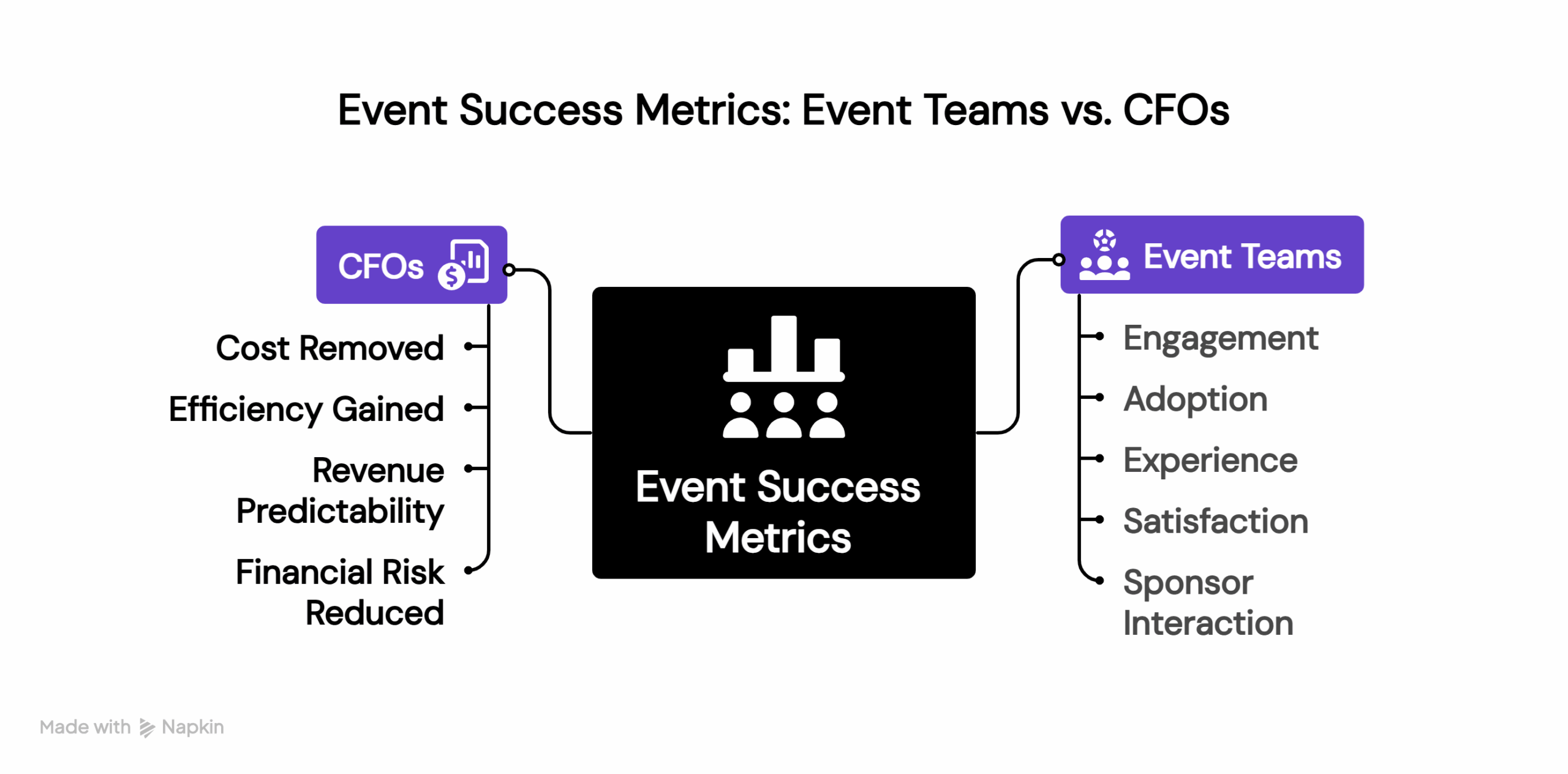
If you look at this, both sides are acting rationally, even when the conversation feels tense.
From an event team’s perspective, engagement metrics are the most immediate and reliable signals available. When adoption is high, sessions are well attended, sponsors are interacting with offers, and attendees are staying active throughout the event, it is reasonable to conclude that the technology is delivering value. These are the signals event teams are closest to, and they are often the same metrics stakeholders ask for during execution.
Now, finance is not disputing those outcomes; however, friction comes in when a CFO looks at the same engagement numbers and asks different questions.
- If sponsor interactions increased, did that lead to more reliable renewals?
- If attendees spent more time on the platform, did that reduce the need for external activation spend?
- If reporting became faster, did that actually reduce costs in the system, or simply compress work into a shorter window?
This tension does not come from disagreement over what happened at the event. It comes from a gap between activity and implication. Engagement metrics describe movement within the experience, while finance seeks to understand whether that movement changed costs, reduced operational pressure, made revenue more predictable, or lowered financial risk.
When engagement is presented as if it already answers those questions, the two sides start talking past each other. Event teams feel they have proven success. Finance feels the proof is incomplete.
Here’s why this gap is getting wider in 2026
According to EventTrack 2026 and BCD’s What’s Trending 2026 report, events are now being discussed at the executive level as strategic investments, not discretionary spend.
That shift brings three consequences that matter deeply for event tech:
- Budgets are being consolidated across portfolios, not approved per event
- Finance and procurement are getting involved earlier
- Every recurring cost is expected to justify itself operationally
In other words, event technology is competing with every other way the organisation could deploy capital.
How CFOs actually evaluate event technology
Event teams often explain efficiency gains in language that makes sense internally. They’ll say things like, “This saved us a lot of time,” or point to performance metrics that show clear improvement in execution. From a finance perspective, however, that framing immediately raises a follow-up question: did the technology actually reduce costs in the system, or did the same people simply work faster?
CFOs are trained to look for change in the operating model, not activity inside a tool.
When they assess event technology, they typically evaluate it across four financial signals.
Not explicitly, but instinctively.
1. Cost avoided
This is the most straightforward signal, and often the least clearly articulated.
CFOs want to understand:
- What manual work no longer needs to happen
- What external vendors or agencies are no longer required
- What duplication or rework has been eliminated
Event teams often describe efficiency gains in ways that make complete sense from inside the delivery team. They’ll say things like, “This saved us a lot of time,” or point to performance metrics that show the system worked better than before.
Let’s say an events team is using Bridged’s Commercial Engine. After the event, the instinct is to share what looks most obviously impressive: digital offers achieved an 8× higher click-through rate than previous activations, or that they collected 10× more first-party data during the event. From an execution standpoint, those are meaningful improvements. They indicate that the audience noticed the offers, interacted with them, and left behind far richer data than in past editions.
Finance, however, listens to those numbers very differently.
When a CFO hears “this saved us time,” the immediate question is whether that time was offset by a cost to the system, or whether the same people simply worked faster with better tooling. And when they hear “8× CTR” or “10× more data,” the instinctive follow-up is not about engagement at all, but about commercial impact: what did that actually generate, protect, or replace?
This shift in interpretation is illustrated clearly in the Informa case study. The team led with strong performance metrics that demonstrated clear adoption and audience responsiveness: digital offers delivered significantly higher click-through rates, and first-party data capture increased materially across their digital channels using the Commercial Engine. These signals mattered. They showed that the experience was working and that audiences were engaging with what was presented to them.
Wait, the story doesn’t stop there.
Alongside these engagement metrics, the same outcomes were translated into an estimated £10,000 in additional demand generation value, attributable to improved offer delivery and richer data capture. By connecting performance inside the platform to a concrete commercial outcome, the team strengthened the case for finance without diminishing the importance of the underlying engagement signals.
Nothing about the outcome itself changed. The engagement, the data, and the technology behaved exactly as before. What changed was the completeness of the story, from describing system activity to explaining its impact on commercial performance. That translation is what made the value immediately legible in a CFO-led conversation.
Unless time saved is connected to:
- Reduced contractor spend
- Fewer outsourced tasks
- Lower dependency on temporary resources
…it doesn’t register as ROI.
2. Operational efficiency gained
As event portfolios scale, efficiency stops being an operational concern and becomes a financial one. From a CFO’s point of view, efficiency is not about whether teams feel less stressed during delivery, but about whether smoother execution changes the cost structure or risk profile of the business.
In theory, this sounds abstract. In practice, it often shows up in very ordinary places, like event support.
Event teams frequently describe operational efficiency improvements by pointing to activity volume. For example, when using an AI-powered support layer like Bridged’s Product Engine, a team might report that it answered thousands of attendee and sponsor questions during an event. That sounds impressive, and from an execution standpoint, it is. It demonstrates adoption, coverage, and responsiveness.
But finance hears something different.
What a CFO wants to understand is not how many questions were answered, but what answering those questions changed operationally. Did it reduce the load on the support team? Did it prevent the need for additional temporary staff? Did it lower the risk of delayed responses or escalations that could impact sponsor satisfaction?
This distinction became clear in our Terrapinn case study. Instead of exclusively framing success around volume, for instance, the Knowledge Agent handling over 4,000 attendee and sponsor queries, the impact was also translated into operational and financial terms. The automated support reduced live support workload by roughly 80%, resulting in an estimated £3,000 saved per event by avoiding additional staffing and support overhead.
The underlying efficiency was the same, but the only difference was in how it was communicated.
Finance felt support because of the smoother execution, which showed up in:
- Reduced pressure on already stretched teams
- Lowered the likelihood of delivery failures or escalations
- Enabled the same team to support more, or larger, events without added cost
Efficiency without consequence is simply a better experience. Efficiency with clearly articulated consequences, in cost, capacity, or risk, is what finance recognises as ROI.
3. Revenue confidence improved
This is where sponsor-facing and commercial event technology is most often under-credited (and under-explained).
From an events or digital team’s perspective, increased sponsor engagement is a clear win. More clicks on offers, higher interaction with content, and richer first-party data all signal that audiences are responding. These are the metrics teams see first, and understandably so.
But for a CFO, engagement on its own is not the end goal. What matters commercially is whether that engagement translates into revenue that can be relied on.
Finance teams are listening for signals such as:
- Clear, defensible evidence of sponsor or partner delivery
- Less reliance on anecdotal success stories during renewals
- Fewer grey areas when commercial value needs to be justified
When outcomes are verifiable, revenue becomes easier to forecast and far less exposed to dispute. That predictability has real financial value, even when it does not immediately appear as new revenue on a P&L.
Take the Africa Tech case study as a useful example of how the same performance story can be presented in a way finance can actually evaluate. Saying that visitors spent twice as long with the event brand after interacting with the experience is a strong engagement-depth signal for the team, but it also does something more important in a CFO conversation: it makes sponsor delivery more defensible by showing that partner touchpoints were not merely placed, but genuinely seen and consumed. And when lead collection rates move from 0.25% to 2.7%, the headline is not just that engagement improved; it is that the event produced a clearer, more comparable pipeline contribution that can be weighed against other ways the organisation could have invested to generate demand.
The goal is to keep engagement metrics as proof of delivery, while translating that proof into the commercial outcomes finance needs to see: clearer sponsor value, a more defensible pipeline contribution, greater forecasting confidence, and fewer disputes during renewal conversations.
4. Financial risk reduced
Risk reduction is rarely visible on event dashboards, but it carries significant weight in finance discussions. While event teams tend to focus on delivery and experience, CFOs are constantly thinking about exposure, particularly in environments where sponsors, partners, and regulators all intersect.
From a finance perspective, risk often shows up in small, unglamorous places. It appears when sponsor deliverables are questioned months after an event. It surfaces when commercial terms are interpreted differently by different teams. It emerges when data usage, consent, or reporting standards are unclear, and no one can quickly produce a definitive record of what happened.
Here’s why CFOs pay close attention to signals such as:
- Whether there is a clear audit trail of sponsor delivery
- Whether proof of delivery is documented and easily retrievable
- Whether disputes can be resolved quickly without refunds or make-goods
Consider a common scenario. A sponsor challenges the value of their package after the event, asking for evidence that agreed placements, impressions, or lead commitments were met. From an events perspective, the delivery may have been flawless. From a finance perspective, the question is whether that delivery can be proven cleanly, consistently, and without manual reconstruction.
When event data is fragmented, answering that question becomes risky. Teams scramble to pull reports from multiple systems, assumptions creep in, and what should be a straightforward response turns into a negotiation. Every unresolved question becomes potential exposure, not just financially, but reputationally.
Event technology that reduces ambiguity does more than improve execution. By creating clearer records, more consistent reporting, and defensible proof of delivery, it reduces the likelihood that disputes will escalate in the first place. That protection rarely shows up as a line item in post-event reporting, but it plays a quiet and critical role in how finance evaluates whether a tool is worth continuing to invest in.
Where internal buy-in usually breaks
In many organisations, event tech adoption happens bottom-up.
- Teams adopt tools to solve real operational pain
- Finance is informed later
- ROI is explained after the event is complete
By the time CFOs engage, the conversation is reactive.
Instead of:
“Here’s what this unlocks financially.”
It becomes:
“Here’s why we need to keep this.”
And that shift makes a world of a difference.
CFOs are far more receptive to anticipated impact than retroactive justification.
What to do before your next budget review
This shift requires a more disciplined way of testing, framing, and proving value before those conversations ever reach finance.
This is where approaches like Bridged’s 3P+ framework become useful as a structured way for event and commercial teams to build a financial case that budget approvers can actually evaluate.
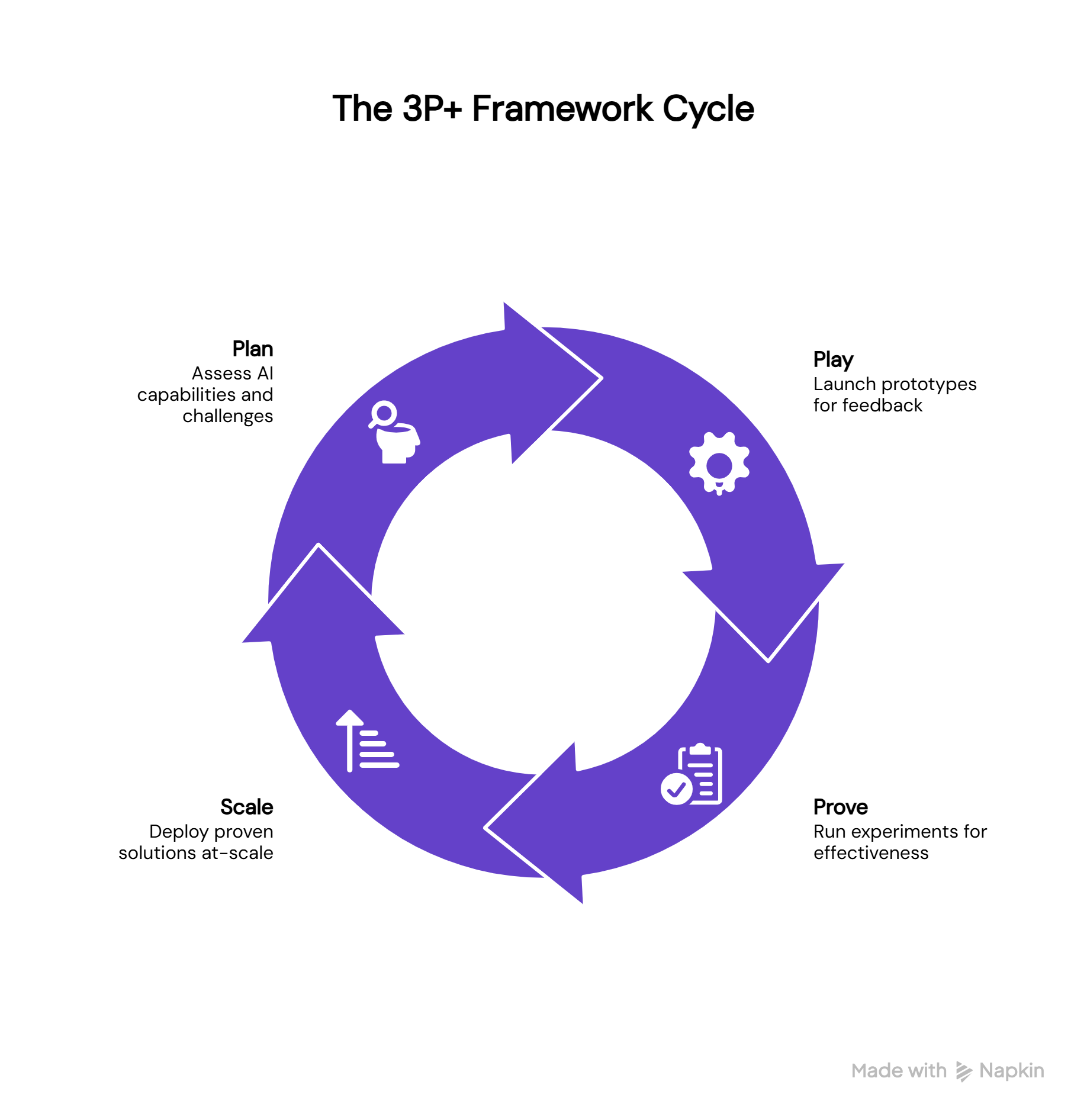
The idea is simple… instead of rolling out new technology and justifying it after the fact, teams move through a sequence that mirrors how finance thinks about risk and return.
- Plan focuses on identifying a real operational or commercial problem, not a feature to deploy. This is where teams assess current workflows, pressure points, and gaps, and define what success would look like in financial terms. For example, reduced support costs, clearer sponsor delivery, or more predictable demand outcomes.
- Play creates space to test those assumptions in a controlled way. Rather than committing at scale, teams launch small prototypes internally or on a limited set of events, gathering feedback and performance data without introducing unnecessary risk or complexity.
- Prove is where the translation happens. Experiments are evaluated not just on engagement or adoption, but on whether they produced measurable outcomes that finance cares about, cost avoided, efficiency gained, revenue confidence improved, or risk reduced.
Only once those signals are clear does the +Scale step come into play, allowing teams to deploy what has already been proven, with far less friction in budget discussions.
Seen this way, the 3P+ approach functions as a testing ground for AI and event technology hypotheses, while also creating a clear, defensible narrative for CFOs and commercial leaders. It shifts the conversation from “trust us, this worked” to “here’s what changed, here’s how we tested it, and here’s why it’s worth scaling.”
When finance can see not just activity, but a structured path from experimentation to proof to scale, approval conversations tend to become simpler and significantly shorter.
In a nutshell
Event technology rarely fails because it lacks value. It fails because that value is described in terms that finance does not use to make decisions.
As events continue to be treated as strategic investments, the language around them must evolve as well. When it does, ROI stops being something teams argue for and becomes something organisations can confidently act on.
FAQs
Q. Why do CFOs often question event tech ROI even when engagement metrics are strong?
Because engagement metrics show activity, not financial impact. CFOs are responsible for capital allocation and risk management, so they look for signals such as cost avoided, operational efficiency gained, revenue confidence improved, and financial risk reduced. Without a clear connection between engagement and these financial outcomes, usage alone is not enough to justify approval or renewal.
Q. What financial signals matter most to CFOs when evaluating event technology?
CFOs typically evaluate event technology across four core signals:
- Whether the technology removes or avoids costs
- Whether it improves operational efficiency and predictability
- Whether it increases confidence in future revenue, especially sponsor renewals
- Whether it reduces financial or contractual risk
These signals help finance understand how the investment changes the business, not just the event experience.
Q. Why do many event tech investments struggle at renewal time?
Most event tech investments struggle at renewal because ROI is framed retrospectively and in experiential terms. By the time finance is involved, the conversation focuses on defending past spend rather than clearly articulating future financial impact. Without a forward-looking, finance-ready ROI narrative, renewals become harder to justify.
Q. How should event teams reframe ROI for a CFO audience?
Event teams should translate operational outcomes into financial language. This includes linking time saved to cost avoided, framing sponsor engagement as revenue confidence, and clearly calling out reductions in risk, disputes, or rework. The goal is to show how the technology changes financial outcomes, not just event performance.
Q. Is event tech ROI about generating new revenue?
Not always. While some tools may support revenue growth, CFOs often place equal or greater value on revenue confidence and predictability. Technology that helps retain sponsors, reduces uncertainty during renewals, or stabilises future income can be just as valuable as tools that generate incremental revenue.
Q. How does operational efficiency translate into financial ROI for event teams?
Operational efficiency becomes financial ROI when it reduces pressure on headcount, lowers reliance on external vendors, or decreases the likelihood of costly errors and escalations. CFOs look for efficiency that changes staffing models, cost structures, or risk exposure, not just smoother execution.
Q. Why is financial risk reduction important in event tech ROI?
Financial risk reduction matters because unresolved sponsor disputes, unclear delivery records, and poor documentation can lead to refunds, make-goods, or reputational damage. Event technology that improves auditability and proof of delivery helps protect the business, even if that value is not immediately visible in revenue numbers.
Q. When should finance be involved in event tech ROI discussions?
Ideally, finance should be involved before the event, not after. CFOs are more receptive to anticipated financial impact than retrospective justification. Early involvement allows event teams to align metrics and reporting with financial expectations from the start.
Q. What is the biggest mistake event teams make when presenting ROI?
The biggest mistake is assuming that strong engagement automatically implies financial value. Engagement is a necessary input, but without clear translation into financial outcomes, it does not answer the questions CFOs are responsible for asking.