



If most of your event is forgotten within a day, what did you actually deliver?
The actual thing (read: takeaway) someone walks away carrying. Because if attendees forget almost everything, then sponsors aren’t buying influence; they’re buying exposure that evaporates. And attendees aren’t buying knowledge or connections; they’re buying a moment that doesn’t stick.
That changes how we should be thinking about and planning events entirely.
Why attendees forget your event (and no, it’s not about attention spans)
The core reason attendees forget events is not distraction or short attention spans. It’s how human memory is structurally designed to work.
The forgetting curve tells us people lose up to 50% of what they’ve experienced within 24 hours, and up to 90% within a week. That’s human memory behaving exactly as it’s supposed to.
Now layer that onto a typical event. There are packed agendas, back-to-back sessions, dozens of conversations, constant stimulation, and almost no time to process anything. It’s high intensity but low retention. We create something that feels valuable in the moment but doesn’t translate into anything meaningful later.
And that’s where the commercial problem begins: because memory is what drives influence. If someone doesn’t remember what they learned, who they met, or why it mattered, there’s nothing to act on. It was just a really well-run day where you had 3 cups of machine coffee, and walked out with no takeaways.
Three structural problems most event teams don’t see until it’s too late
Poor event retention isn’t random. It comes from three structural problems that most teams are still designing around rather than designing out.
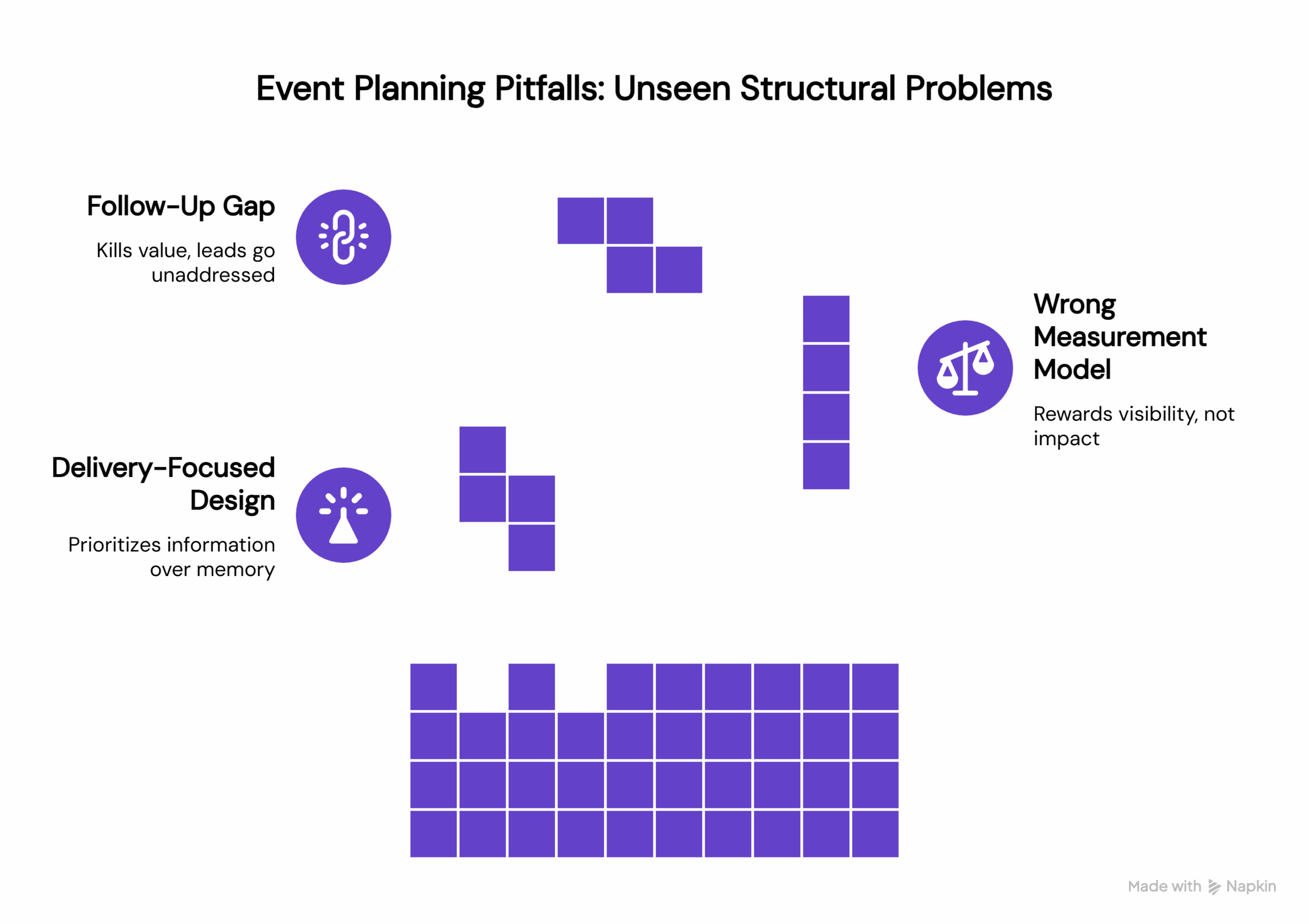
1. Events are designed for delivery (not retention)
Most agendas are still built like broadcast schedules: fill the day with panels and keynotes that look strong on paper, optimise for coverage and variety, not for what people will actually remember.
Attendees remember moments, including a sharp insight that clicked, a conversation that reframed something, and a specific example that felt directly relevant to their work, and most event formats don’t create space for that; they prioritise information flow over memory formation.
There’s also a clear gap between what attendees want and what they actually get. Research consistently shows that 42% of attendees prefer interactive, hands-on formats, but most events still default to passive listening. So we end up delivering a lot, and very little of it sticks.
2. The measurement model rewards the wrong things
This one might feel subtle, but it’s probably the most dangerous.
Most post-event reports look nice on paper. Attendance was strong, sessions were full, the app saw activity. And yet, when you try to trace what actually changed because of the event, things get a little blurry.
Part of the issue is how we measure success. Around 70% of B2B marketers still rely on engagement metrics like attendance, participation, and digital interactions to evaluate their events. Only 46% actually measure financial ROI.
So the system ends up rewarding visibility and activity, not retention or real impact. Which means you can run a “successful” event where nothing meaningful carries forward, and nobody notices until the renewal conversation gets difficult.
3. The follow-up gap kills everything
This stage is where most of the value disappears.
Someone attends a session, has a good conversation, and maybe even expresses genuine interest; there’s a real moment of intent. And then nothing happens; there’s no connection back to what they actually cared about.
A significant number of event leads go unaddressed. Even when teams do follow up, it’s generic and disconnected from the original interaction. The conversation that started at the booth or during a session doesn’t really continue, it just gets replaced with a templated email blast.
And this isn’t a small leak. Nearly 80% of trade show leads never receive any follow-up at all. Sponsors invest in presence, attendees exchange cards, conversations feel promising in the moment, and within a week, most of it simply evaporates because there’s no system to carry that context forward.
So whatever was learned, discussed, or sparked just fades out because nothing was built to extend it.
What actually changes when you design for retention
At some point, I had to stop thinking about events as content delivery platforms and start thinking about them as memory systems.
That sounds abstract, but it’s actually very practical. If the goal is to influence decisions, build relationships, and drive outcomes, then what people retain matters far more than what you present.
The question changes from “What did we deliver?” to “What did they keep, and what did they do with it?” And once you start looking at it that way, a lot of current practices start to feel incomplete.
-
Designing for peak moments, not packed agendas
As you’d agree, attendees remember specific moments that stood out: a session that directly answered a problem they’d been wrestling with, a conversation that reframed something important, or a format that made them participate instead of just listen.
And yet, most events are still built around passive formats. Even though 42% of attendees say they prefer interactive, hands-on experiences, the default is still panels and keynotes.
Events that intentionally create these moments tend to perform very differently. Research shows that attendees who experience a clear, goal-aligned peak moment are far more likely to return, because they can point to something that actually mattered to them.
So instead of asking, “How do we fill the agenda?”, the better question becomes, “Where are the moments that will actually stick?”
-
Connect content to the attendee
One of the biggest gaps in retention starts before the attendee even arrives.
When someone walks into a session that clearly connects to a challenge they are already trying to solve or sits down for a meeting knowing exactly why it is worth their time, the event stops feeling like a generic conference schedule and starts feeling personally useful. That’s what improves recall and what lifts NPS. People will always remember what felt relevant to them.
This is exactly where Bridged’s Connections Workflow comes in.
It gives event teams three practical ways to make the experience feel more personally meaningful from the start: personalised agendas shaped around each attendee’s actual interests (not just a broad job title); matchmaking meetings with a clear strategic reason behind every introduction, so people aren’t left wondering why they are in the room; and communications sent through the channels attendees already pay attention to, so the event stays visible instead of getting lost in yet another event app or inbox folder.
All three work on the same idea. When an experience feels chosen for you, you engage with it differently. You pay closer attention. You assign more value to it. You are far more likely to remember it after the event is over.
The goal is not to produce more content or add more noise. It is to make the content, conversations, and touchpoints feel like they were selected with intention for the person receiving them.
That’s the difference between an event someone attended and an event they actually remember.
-
Extending the event beyond the venue
The first 24 to 48 hours after an event are when recall is high and intent is still fresh. It’s the most valuable window you have, and most teams treat it like an afterthought.
A generic thank-you email goes out, maybe a content recap. And that’s usually where it ends.
This is exactly where the drop-off happens. Nearly 80% of trade show leads never receive any follow-up at all, which means the conversations that felt promising during the event simply don’t go anywhere once it’s over.
What should happen is far more intentional. Follow-ups that reflect what someone actually engaged with. Nudges that reconnect them to the conversations they had. Opportunities to continue interactions with sponsors or peers while the context is still fresh.
If the event creates the spark, the next step is where you decide whether it turns into something that lasts.
-
Turning sponsor presence into sponsor memory
Retention-first design changes what sponsorship is worth.
Most sponsors are still buying visibility, which can include a logo on a lanyard, a banner on a stage, or a mention in the welcome remarks. The problem is, visibility fades at the same rate as everything else people forget once the event ends.
If the goal is for a sponsor to be remembered and, more importantly, acted on, then presence isn’t enough. The format has to give them a role in something attendees actually value.
This is where Bridged’s Sponsorship Workflow shifts the equation.
Instead of treating sponsors as add-ons to the experience, it builds them into moments that already matter. A curated introduction that makes sense for both sides. A resource that shows up when it’s actually useful. A follow-up that continues a conversation instead of restarting it.
Now the sponsor isn’t sitting on the sidelines waiting to be noticed. They’re part of what the attendee remembers.
And that changes the commercial outcome. Because when a sponsor can point to specific interactions, conversations, and next steps, the value stops being abstract. It becomes something you can actually track.
That’s what turns sponsorship from a visibility play into something that holds up in a renewal conversation.
What kind of event do you want to be remembered for?
Lately, I’ve been asking myself a very simple question before every event:
What will people remember a week later? And what will they actually do because of it?
Because the difference shows up in what is carried forward, once everyone goes back to their real lives.
Most events are built to impress in the moment. Very few are built to stay with people.
And once you start thinking this way, you realise it’s not just a retention problem. The same pattern shows up everywhere. In the drop-offs before someone even registers. In sessions that feel good but don’t lead anywhere. In conversations that never turn into anything. In sponsor value, it looks fine on paper, but is hard to defend later.
And it shows up in small gaps across the entire experience.
We put together a quick diagnostic to help teams figure out where those gaps actually are.
You choose your event type and what you care about most right now, and it gives you a focused breakdown of where to look, what to fix, and what strong execution looks like for events like yours.
If you’re trying to make your next event actually carry over, here’s where to get started.
FAQs
Q1. Isn’t forgetting just human nature, what can events realistically do about it?
Yes, forgetting is natural. But the forgetting curve isn’t fixed, it flattens significantly when experiences are emotionally resonant, contextually relevant, or followed up on promptly. Events can’t beat memory science, but they can work with it rather than against it.
Q2. We already send post-event emails. Isn’t that enough?
A generic recap email goes out to everyone and connects to no one specifically. What actually extends retention is follow-up that reflects what a specific person engaged with, the session they attended, the conversation they had, the question they asked. That level of specificity is what turns a moment of intent into something actionable.
Q3. How is this different from just improving content quality?
Better content helps, but it’s not the bottleneck. An attendee can sit through a genuinely excellent session and still forget most of it by the next morning if there’s no structure to help them process and apply it. Retention-first design is about the architecture around the content, not just the content itself.
Q4. Does this only apply to large events?
The forgetting curve applies at every scale, but the stakes are higher at larger events where there’s more competition for attention and less natural intimacy. That said, even small events leave a lot of value on the table when there’s no intentional follow-through after the room empties.
Q5. Where do sponsors fit into this?
Significantly. If attendees don’t retain the interactions they had with sponsors, the ROI case for sponsorship weakens. Retention-first design actually strengthens the sponsor proposition, when attendees remember a conversation and follow up on it, that’s attributable value sponsors can point to at renewal.