



Cost per registration is the metric most B2B event teams report on. It is also the most lagging metric in the funnel.
By the time the number is calculated, the waste has already happened upstream, in the gap between someone showing interest in the event and someone clicking the registration button. Most event teams are not watching that gap.
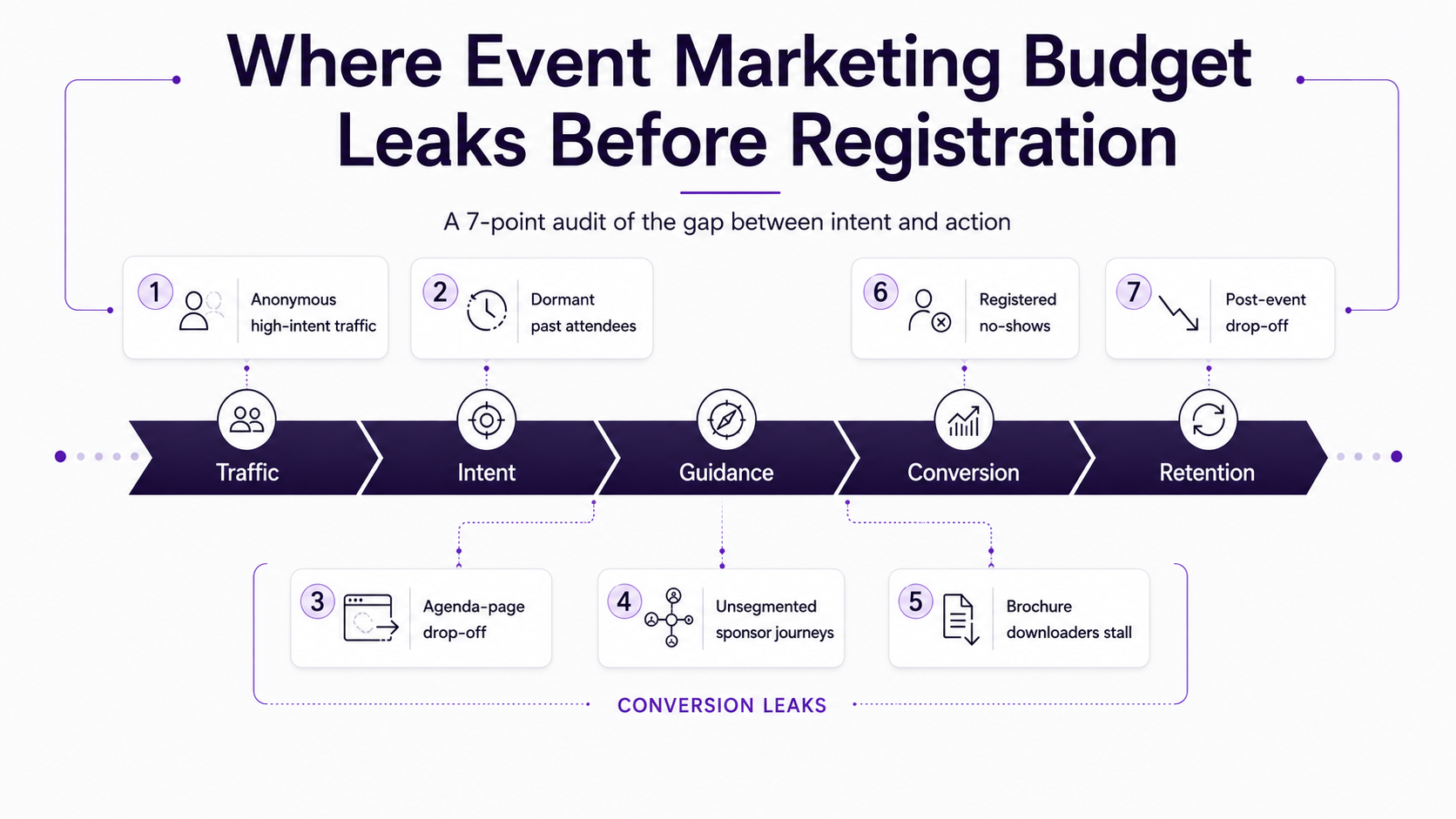
Event acquisition budget leaks before the registration form. It leaks across at least seven specific moments, most of which are visible in data event teams already have. One industry analysis found a consistent 30 to 40 percent of event marketing spend underperforming or effectively wasted, much of it lost upstream of the registration form. Once you know where to look, the leaks are diagnosable in an afternoon.
This is a self-audit. Seven leak points. Run it against your last event and you will surface where your acquisition spend is being lost. It is the diagnostic that comes before the fix: once you know where the budget goes, you can start to increase registrations without increasing budget.
How much high-intent event website traffic are you losing before registration?
A visitor reads four session abstracts, opens the registration page, closes it, and leaves. Your team has no idea who they were.
Agenda, speaker, and pricing pages are where high-intent traffic congregates and disappears unidentified. Across B2B sites broadly, data shows that 97 percent of visitors leave anonymous, and most events sit in that range too.
How to measure it:
Look at the share of sessions on high-intent pages that do not result in a form submission, registration start, known-user identification, return visit, or another measurable next step. Segment this by page type: agenda, speaker, pricing, sponsorship, and registration pages will all show different levels of intent.
The key question is not just how many people visited those pages, but how many showed enough intent to be worth acting on, but still left anonymous.
What good looks like:
Intent capture happens at the moment of curiosity, well before the registration wall is presented. After a visitor views multiple sessions, an interactive poll might ask which topic they are most interested in. The interaction is light, the value exchange is clear, and the email capture comes only when it makes sense.
A parallel move is an always-on concierge that answers common questions and guides visitors to the right page before they lose interest. Done consistently, anonymous traffic becomes identifiable demand, and the team has clearer signals on who is moving towards conversion.
How many past attendees are sitting dormant in your event CRM?
For most organisers, the past-attendee CRM is the largest audience the event has and the least intelligently treated.
Generic launch blast in week one, reminder in week six, final push two weeks out. The delegate who attended in 2024 and missed 2025 gets the same opening line as a stranger from a cold list.
How to measure it:
Take your past-attendee list. Count the share who have received personalised, intent-aware reactivation outreach in the current cycle. The generic announcement email does not count.
Then segment by behaviour and recency. How many past attendees opened recent campaign emails, returned to the website, viewed the agenda, clicked pricing, downloaded a brochure, or engaged with content tied to their previous interests? If this audience exists in your CRM but is not being activated differently from cold traffic, acquisition spend is being wasted.
What good looks like:
Past attendees are segmented by recency, role, event history, content interest, and commercial value. Someone who attended last year, saved sustainability sessions, and missed this year’s launch should not receive the same message as a first-time prospect.
The sequence starts early and adapts as intent appears. A visitor showing renewed interest in a specific track is guided towards the relevant agenda, speakers, networking opportunities, or registration offer. For maximum reach, the workflow can extend beyond email into channels where the audience already engages, such as WhatsApp or app messaging.
Is your event agenda page helping visitors convert or making them bounce?
The agenda is the most commercially loaded surface on most event sites and one of the most static.
A flat list sorted by day, no filters, no behavioural signal back to the event team. A visitor scrolls, picks out three sessions in their head, and leaves with no way to come back to that selection.
How to measure it:
Start by mapping the agenda journey, not just the agenda page. Look at how many visitors reach the agenda, how long they spend there, which filters or session pages they engage with, and what they do next. The key question is: does agenda engagement lead to a meaningful next step?
Track the share of agenda visitors who go on to view pricing, start registration, complete registration, save a session, add something to calendar, request more information, or become an identified lead. Then compare that with visitors who view the agenda and leave without taking any action.
If the agenda gets traffic but does not create downstream movement, it is functioning as a content archive rather than a conversion surface.
What good looks like:
The agenda functions as a guided journey rather than a static index. Filterable interfaces by topic, seniority, function, format, and interest make discovery easier, but the real shift happens when the agenda captures intent.
A “build your agenda” experience allows visitors to curate sessions, then offers to email the personalised schedule. That turns a browsing moment into a high-intent signal. The agenda stops being a passive information wall and becomes a conversion surface that captures interest when curiosity is highest.
Are sponsor and attendee visitors being sent through the same website journey?
Attendees, sponsors, exhibitors, speakers, and partners often land on the same event website, but they are not looking for the same outcome.
An attendee wants to know whether the event is worth their time. A sponsor wants to understand audience quality, package options, budget fit, lead potential, and proof of ROI. If the site does not segment them early, sponsor intent gets buried inside generic traffic.
How to measure it:
Look at the share of website visitors who reach sponsor, exhibitor, partnership, pricing, or audience pages but do not take a sponsor-related action. That could be requesting a media pack, viewing packages, submitting an enquiry, booking a meeting, or becoming an identified sponsor prospect.
Then review the journey that got them there. Were they ever asked who they were? Were they routed to sponsor-specific information? Did the tools on those pages answer with commercial context, or did they behave like a generic attendee support experience?
If sponsor-intent visitors are browsing commercial pages but not converting into named enquiries or qualified opportunities, the journey is not doing enough to recognise them.
This is the same qualification gap we explore in more detail in our guide to turning high-intent event visitors into qualified leads, where we break down how sponsor, attendee and agenda interest can be captured while it is still active.
What good looks like:
Audience segmentation starts as soon as intent appears. Interactive elements identify whether someone is attending, sponsoring, exhibiting, speaking, or exploring partnerships, then adapt the journey accordingly.
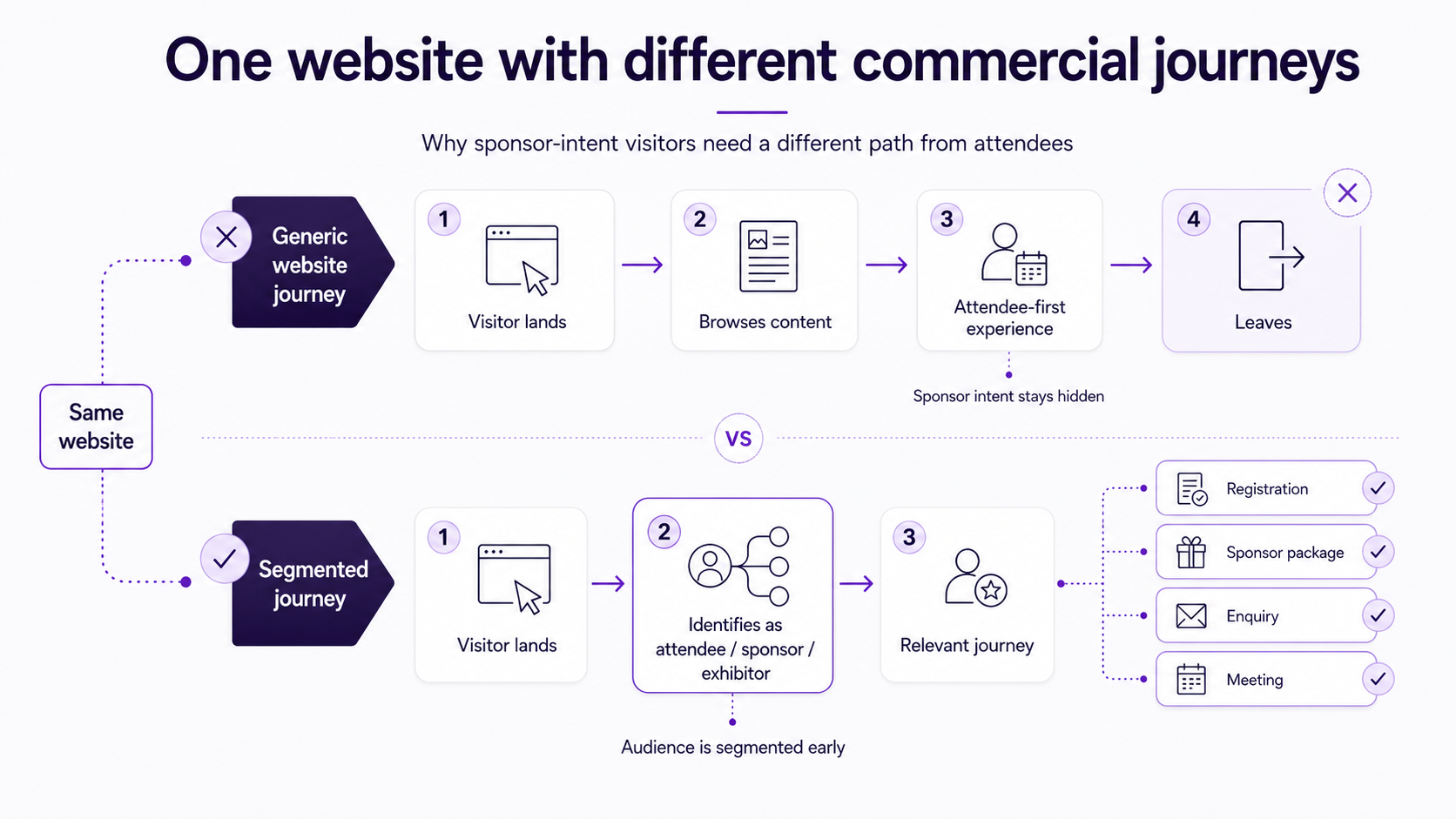
A sponsor prospect should be guided towards audience data, package options, case studies, and commercial next steps, not pushed through an attendee-first experience. Tools on sponsor pages should also respond with sponsor-specific context. Instead of building a personalised agenda, for example, they might recommend packages based on the sponsor’s goals, audience priorities, budget, and desired visibility.
Done well, segmentation turns anonymous sponsor interest into qualified commercial demand.
Why do brochure downloaders fail to become event registrations?
The brochure download is one of the strongest intent signals an event site collects. The visitor has given up their email, declared interest, and asked for more information.
But too often, that intent is treated as a completed conversion rather than the start of a nurture journey. A generic “thank you, register now” email lands days later, with no reference to what the visitor actually explored.
How to measure it:
Look at all brochure downloads from the last campaign and track what happened next. What share returned to the site, viewed pricing, started registration, completed registration, or engaged with follow-up content?
Then compare conversion by behaviour: visitors who downloaded after viewing the agenda, sponsor pages, pricing, or speaker profiles will not all have the same intent. If most brochure downloaders never take a second action, the nurture journey is too weak.
What good looks like:
A brochure download triggers a behaviour-led nurture sequence based on what the visitor viewed before and after the download. Someone who browsed pricing gets a different follow-up from someone who spent time on the agenda or sponsor pages.
The goal is to guide the visitor towards the next most relevant action while intent is still warm.
Are registered no-shows being treated as lost attendees or warm future prospects?
Registered no-shows are often treated as cold leads in the next cycle, but they are one of the strongest pre-qualified audiences an event has. With average in-person event attendance sitting around 60 to 70 percent of RSVPs, no-shows typically form the second-largest pre-qualified audience the event has after past attendees.
They already crossed the registration threshold once. Something stopped them from attending, but the original intent still matters.
How to measure it:
Take the no-show list from the last edition and track how many were reactivated in the current cycle. Look at email engagement, website return visits, agenda views, early-bird registrations, and completed registrations.
The key question is not just whether they were contacted, but whether they were treated as a distinct segment with messaging that acknowledges their previous intent.
What good looks like:
No-shows are flagged as a high-priority reactivation segment from day one of the next cycle. Instead of receiving the same launch message as everyone else, they get a sequence that recognises the missed edition and gives them a fresh reason to attend.
That could be new speakers, new formats, improved networking, a stronger agenda, or a limited early-bird offer. The message should not imply they are starting from zero. They already showed intent once; the job is to reactivate it.
Are you losing next year’s registrations in the first 72 hours after your event?
This year’s attendee becomes next year’s lead almost immediately after the event ends.
The 72-hour window after the event closes is the highest-intent moment for the next cycle. The attendee has just had the experience: the sessions, the conversations, the people. The catch is that memory of it fades fast, with attendees forgetting around half of an event within 24 hours. Most event teams spend that window on thank-you emails and a generic recap, then go quiet for ten months.
How to measure it:
Look at the share of last edition’s attendees who received intent-aware follow-up in the first 72 hours, 30 days, and 90 days after the event.
Then track how many engaged with post-event content, viewed next-year information, registered interest, referred a colleague, joined the newsletter, or returned to the site. If the only post-event touchpoint is a generic thank-you email, the lifecycle journey is leaking.
What good looks like:
Post-event engagement runs as a structured 90-day nurture journey, not a one-off wrap-up. The first 72 hours are used to capture feedback, surface relevant content, identify future interest, and move attendees into next-cycle segments.
Done well, the event does not end when the doors close. It becomes the starting point for the next registration cycle.
Closing the leaks between event intent and revenue
The seven leaks split into two operating motions:
- Leaks 2, 6 and 7 are activation problems. They are about identifying and re-engaging the audience you already have.
- Leaks 1, 3, 4 and 5 are acquisition problems. They are about converting the audience you do not have yet, starting with the visitors who leave your site unidentified.
Bridged closes both through AI workflows that run on top of the event stack an organiser already has. Nothing is replaced and nothing is migrated.
The Activation workflow brings back the audience you already have, reactivating past attendees, lapsed registrants and no-shows with messaging that recognises what they did last time. The Acquisition workflow converts the audience you do not have yet, turning anonymous website visitors into captured, qualified sign-ups. Where registrations land but people do not turn up, the Attendance workflow keeps them warm as the event nears and supports them on the day.
At AI Summit New York, Informa ran the Acquisition workflow across the event website. Visitors were guided through the site towards high-intent actions, and contextual micro-polls captured zero-party intent as they went. Across the cycle: 20 percent engagement, 12 percent conversion from those interactions, twice as long on site for engaged users, and 90 percent higher return rate to the AI Summit page.
Read the full AI Summit New York case study.
The leaks are diagnosable in an afternoon. Closing them is a quarter’s work.
Where to start
Three moves for the Head of Marketing reading this.
First, run the audit. Take each of the seven leak points and score the last event against them. The exercise should take a single afternoon and will show where acquisition spend is being lost.
Second, pick one leak and fix it first. For many organisers, the biggest leak is the dormant past-attendee database. It is usually one of the largest audiences, one of the warmest audiences, and one of the easiest to operationalise.
Third, change the metric. The number to watch is the share of reached audience that converts to a named commercial outcome: registration, qualified lead, sponsor interaction, activated past attendee, or sponsor enquiry. Cost-per-registration alone will tell you only what happened after the waste had already occurred.
If a walkthrough of where your own acquisition spend is leaking would help, Bridged runs 30-minute diagnostic sessions.
FAQ
What is acquisition efficiency in event marketing?
Acquisition efficiency is the share of reached audience that converts to a named commercial outcome: registration, qualified lead, sponsor interaction, or activated past attendee. It gets measured across the full lifecycle. Cost-per-registration alone, calculated at the end, misses where most acquisition spend is being lost.
How do you measure where event marketing budget is being wasted?
The seven leak points covered in this audit cover the upstream waste that cost-per-registration cannot see: anonymous high-intent traffic, dormant past-attendee database, agenda-page bounce, sponsor-page browsers, brochure downloaders who do not register, registered no-shows, and post-event drop-off. Each leak has a measurable signal in data the event team already has.
Should event teams prioritise acquiring new audiences or activating existing ones?
For most organisers, the existing audience of past attendees, brochure downloaders, no-shows, and sponsor-page browsers is significantly larger than any single event they run. It also converts at higher rates than cold audiences. The starting point is almost always activation of what is already there, before any extra spend on cold acquisition.
What is the biggest acquisition leak for most event organisers?
The dormant past-attendee database. The audience is already in the CRM, the conversion rates from it are typically several times higher than from cold acquisition, and it is the easiest leak to operationalise. The activation work can usually start within a single cycle and produce measurable conversion lift before the next event.